The Great Humanoid Race: Beyond the Hype
For decades, the idea of a mechanical butler was relegated to the realm of Saturday morning cartoons and high-budget sci-fi films. You probably remember Rosie from The Jetsons or the helpful, if slightly anxious, droids from Star Wars. In 2024, that fantasy is colliding with hardware reality. We are no longer looking at clunky machines that roll on wheels; we are looking at bipedal humanoids designed to navigate a world built for people.
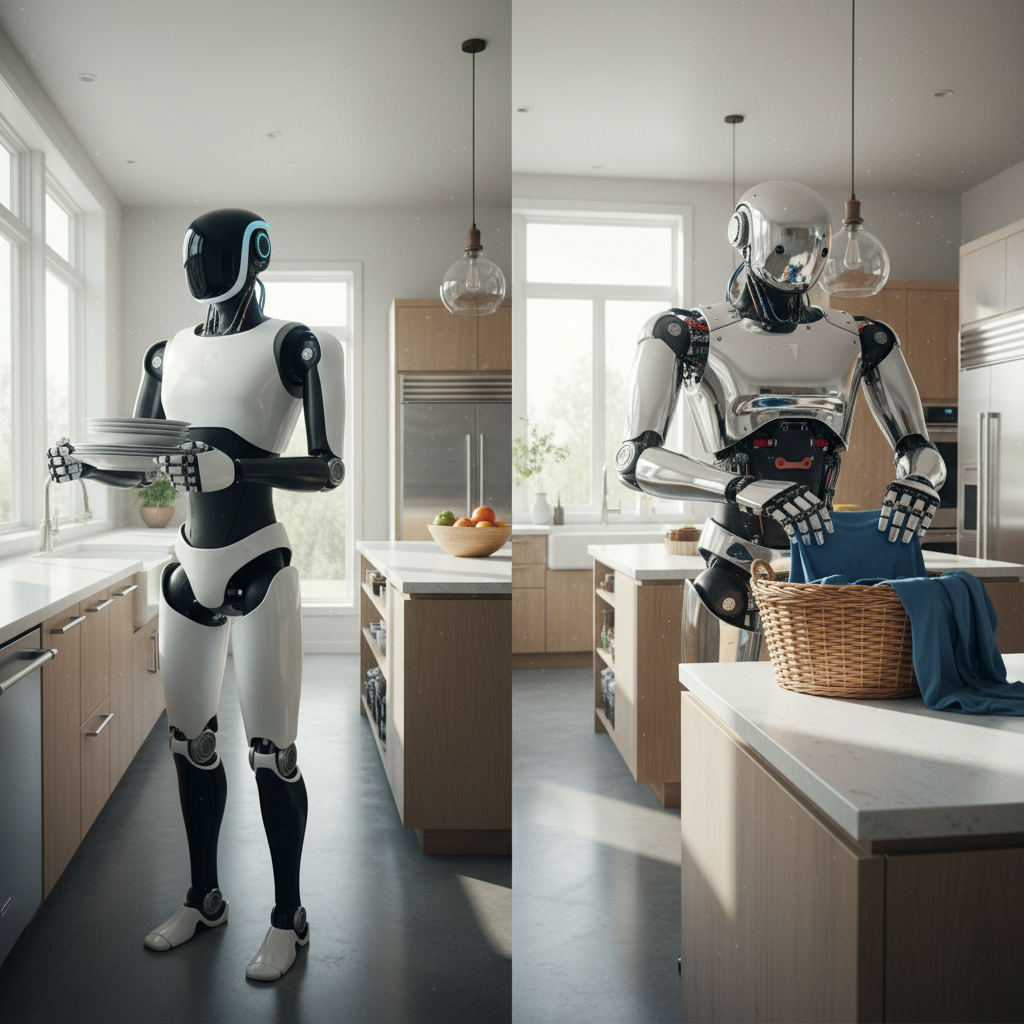
Two major players have emerged as the frontrunners in this domestic revolution: Tesla and Figure AI. Elon Musk’s Optimus (Tesla Bot) and Brett Adcock’s Figure 01 are currently locked in a technological arms race. But behind the sleek metal casings and the viral videos of them walking across warehouse floors, a deeper question remains: Which of these machines is actually going to do your laundry first? To answer that, we have to look past the marketing and examine the sheer processing power and sensor arrays required to distinguish a coffee mug from a wine glass.
The Hardware Specs: Sensors That Mimic Human Senses
Human beings take for granted the sheer complexity of picking up a sock. We use stereoscopic vision to judge depth, haptic feedback in our fingertips to feel the fabric’s friction, and a lifetime of spatial data to know that the sock belongs in the hamper, not the oven. To a robot, a messy living room is a chaotic nightmare of unstructured data.
Vision Systems: Cameras vs. LiDAR
The Tesla Bot relies heavily on what Tesla calls “vision-only” navigation. This is the same philosophy they use for their cars. Optimus uses 2D cameras to feed a neural network that interprets the 3D world. By using multiple cameras to create a 360-degree view, the robot builds a “vector space” of its environment. If you move a chair, the robot needs to update its internal map in milliseconds to avoid tripping.
Figure 01, while also vision-heavy, focuses intensely on the interaction between vision and language. Through its partnership with OpenAI, Figure 01 doesn’t just see a red apple; it understands that “red apple” belongs to the category “food” and should be handed to the person who said “I’m hungry.” This semantic understanding is the secret sauce for home chores. A robot that can walk but can’t identify a dirty dish is just an expensive paperweight.
Haptic Feedback and Actuators
Domestic chores require a delicate touch. If a robot applies the same pressure to a ceramic plate as it does to a heavy crate, you’re going to end up with a kitchen full of shards. Tesla has been developing its own custom actuators—the motors and gears that act as the robot’s muscles. These actuators are designed for high torque-to-weight ratios, allowing Optimus to move smoothly. However, the real challenge is in the fingertips. Both companies are racing to integrate tactile sensors that measure “normal force” (pressure) and “shear force” (sliding), allowing them to grip a slippery glass without crushing it.
The Brain Power: Processing 10 Terabytes of Reality
If the sensors are the eyes and skin, the onboard computer is the brain. Running a humanoid robot requires more local processing power than almost any other consumer electronic device in history. You cannot rely strictly on the cloud; even a 50-millisecond lag in your Wi-Fi could result in the robot falling over or dropping a boiling pot of pasta.
Tesla’s FSD Computer Integration
Tesla has a massive head start here. They are repurposing the FSD (Full Self-Driving) hardware from their vehicles to run Optimus. This hardware is specifically optimized for running deep neural networks at high speeds with low power consumption. By training their models on “Real World AI”—data gathered from millions of cars on the road—Tesla is teaching Optimus how to predict movement in its periphery. This is crucial for a home environment where pets or toddlers might suddenly dart across the robot’s path.
Figure AI’s Neural Network Architecture
Figure 01 takes a slightly different approach by focusing on “end-to-end” neural networks. In a recent demonstration, Figure 01 showed it could perform tasks while having a conversation. This requires a dual-processing track: one part of the brain manages the high-frequency balance and motor control (staying upright), while the other manages high-level logic (listening to instructions and planning a sequence of movements). Figure’s advantage lies in its ability to map speech directly to actions without a middleman software layer, making the interaction feel remarkably human.
The Chore Checklist: Who Wins Which Task?
To determine who is closer to “chore-ready,” we have to break down common household tasks by their technical difficulty. Not all chores are created equal in the eyes of an AI.
1. Folding Laundry (Difficulty: Extreme)
Surprisingly, folding laundry is one of the hardest things for a robot to do. Fabric is non-rigid. Every time you pick up a shirt, it changes shape. This requires “dynamic manipulation.”
- Tesla: Has shown videos of Optimus folding a shirt, but it was reportedly teleoperated (controlled by a human behind the scenes).
- Figure 01: Is focusing on more static tasks first, but their integration with vision-language models suggests they might better understand the “logic” of a folded pile sooner.
Current Leader: Tesla (Optimus has slightly better fluid arm movement), but it’s still a work in progress for both.
2. Kitchen Cleanup and Loading the Dishwasher (Difficulty: High)
This requires identifying different materials (glass, plastic, metal) and understanding how to nest items to save space.
- Figure 01: Recently demonstrated the ability to pick up trash, put it in a bin, and move dishes based on verbal commands. Their precision in placing a coffee pod into a machine was a massive signal that they are winning the “small object” game.
- Tesla: Optimus excels at repetitive, warehouse-style movements, which translates well to moving heavy pots, but lacks the finesse for delicate glassware seen in the latest Figure demos.
Current Leader: Figure 01.
3. Tidying Up and Organization (Difficulty: Medium)
Scrubbing a floor or picking up toys requires endurance and spatial mapping.
- Tesla: Their experience with navigation is their “ace in the hole.” Optimus can likely map a 3,000-square-foot home more efficiently than Figure 01, finding the most logical path between the living room and the toy box.
Current Leader: Tesla.
The Power Problem: The 2-Hour Battery Wall
None of this matters if the robot needs to nap every 45 minutes. A human can work for 16 hours on a bowl of oatmeal. Current humanoid prototypes are lucky to get 2 to 4 hours of battery life before they need a charging station. The processing power required to run their “brains” is a massive drain on the batteries located in their torsos.
Tesla is using high-density battery packs similar to those found in their car modules. This gives them a weight advantage, but the heat generated by the onboard FSD computer is a significant hurdle. Figure 01 is also facing this thermal challenge. If the robot gets too hot, its processors throttle, and its movements become jerky and unstable. Solving the “thermal-to-torque” ratio is the invisible barrier keeping these robots out of our homes until at least 2026 or 2027.
Training Data: The Real Secret to Success
Why is Tesla so confident they can win? Because they have the data. AI thrives on examples. To teach a robot to walk, you can’t just write code; you have to show it thousands of hours of video of humans walking and then let it practice in a simulation millions of times. Tesla’s “Dojo” supercomputer is designed specifically to train these models at scale.
Figure AI is taking a more surgical approach. Instead of broad data, they are focusing on “foundation models” for manipulation. They believe that if you teach a robot the fundamental physics of how objects move, it can figure out the chores on its own without needing a video for every single type of plate or cup in existence. It’s the difference between memorizing a book and learning how to read.
Safety and the “Human Factor”
The most significant hurdle isn’t technical—it’s safety. A 160-pound metal robot falling over could crush a coffee table or, worse, a pet. Figure 01 and Optimus both use “compliant actuators,” which act as electronic springs. If the robot’s arm hits an unexpected object (like your arm), the sensors detect the resistance and instantly cut power or reverse the movement. This “active safety” is what separates a factory robot (which will break your arm without noticing) from a home assistant.
The Verdict: Who Joins Your Household First?
If you want a robot that can move heavy boxes, navigate your hallway with the precision of a self-driving car, and benefit from the most advanced manufacturing scale on the planet, Tesla’s Optimus is the winner. Tesla knows how to build millions of things at a time. They are the only ones who can realistically bring the price down to the $20,000 range in the next decade.
However, if you want a robot that you can actually talk to—one that understands that “the blue cup is dirty” and can use its fingers to pick up a single grape—Figure 01 currently looks more promising. Their partnership with OpenAI has given them a “reasoning” capability that Tesla hasn’t yet publicly demonstrated to the same level of conversational fluidity.
We are watching the birth of a new appliance category. In five years, we won’t be comparing specs on a screen; we’ll be watching these machines autonomously clearing the dinner table while we sit on the couch. The hardware is nearly there; the software is catching up; but the chores? The chores are finally meeting their match.
Frequently asked questions
Can Figure 01 actually talk and do tasks at the same time?
Figure 01 is currently winning in the dexterity department thanks to its partnership with OpenAI, allowing it to understand voice commands and manipulate small objects (like a coffee pod) with high precision in real-time.
What is the ‘brain’ inside the Tesla Bot?
Tesla’s Optimus leverages the FSD (Full Self-Driving) computer used in its cars. This gives it a massive advantage in navigating complex, crowded indoor environments without getting stuck.
Why can’t I buy a humanoid robot for my home yet?
Safety is the biggest hurdle. These robots are heavy and strong. To work in a home, they need ‘compliant actuators’ that stop the robot if it accidentally bumps into a human or a pet.
How many motors are needed for a robot to have human-like hands?
The ‘2 Dozen DOF’ (Degrees of Freedom) hand is the gold standard. To do dishes or fold laundry, a robot needs at least 11 to 24 points of movement in each hand to mimic human grip patterns.