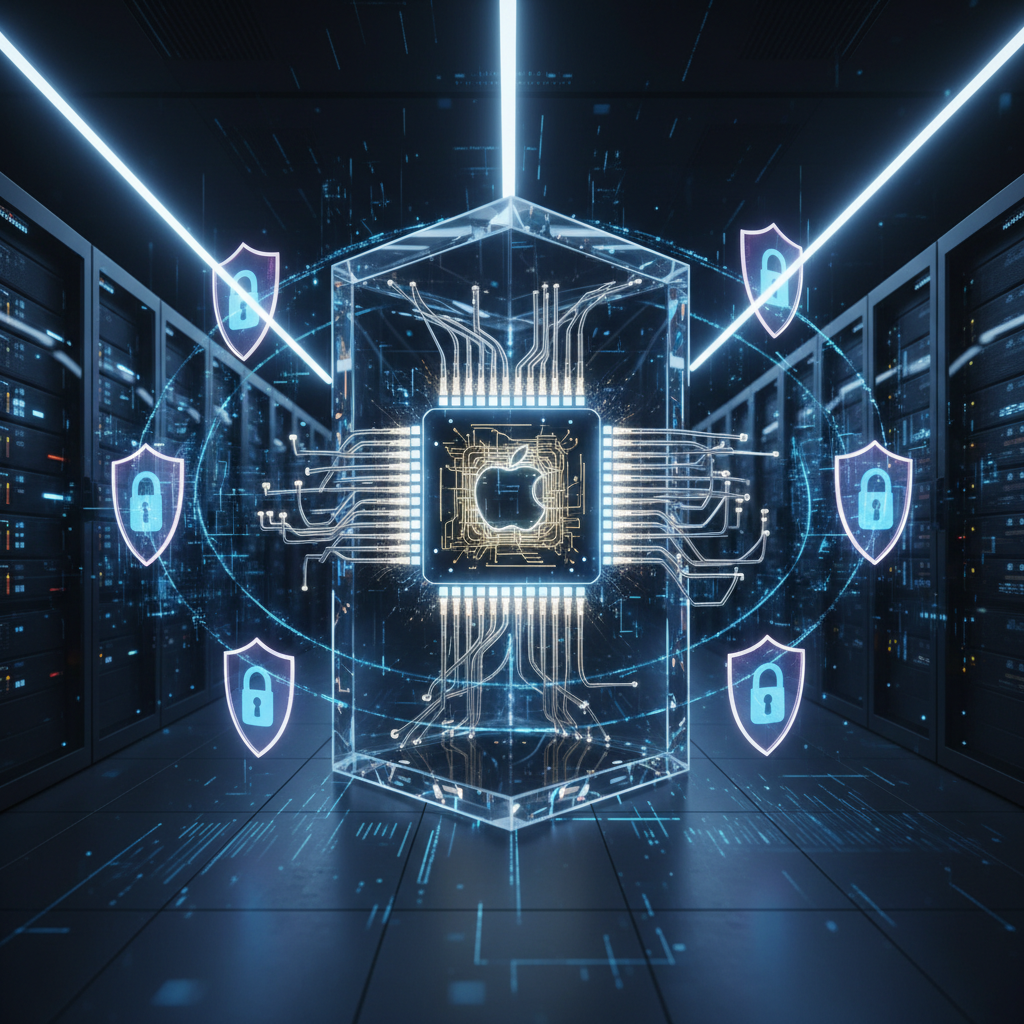
Privacy in the Age of Generative AI
For years, the tech industry has operated on a silent bargain: you get the convenience of powerful AI, and in exchange, the service provider gets your data. Whether it is training future models or serving targeted ads, your personal information is the fuel for the engine. Apple, however, is attempting to rewrite that script with Apple Intelligence. By integrating large language models deep into iOS, iPadOS, and macOS, Apple is promising a level of utility that usually requires surrendering your life story to a data center.
The central question everyone is asking: Is it actually private? When your iPhone determines that a request is too complex to handle on its local A18 chip, it sends that data to a server. In the past, “the cloud” was synonymous with “someone else’s computer.” Apple claims its new Private Cloud Compute (PCC) architecture ensures that your data is never stored, never accessible to Apple employees, and never used for training. Let’s pull back the curtain on the silicon and code making this possible.
The On-Device First Mantra
Before we even talk about the cloud, we have to talk about your pocket. Apple Intelligence is built on a “local first” philosophy. Most of the AI magic—like rewriting an email for a more professional tone or summarizing a text message—happens entirely on your device. This is the gold standard for privacy because the data never leaves your hardware. It lives and dies in the Secure Enclave of your iPhone.
However, small devices have limits. You cannot run a trillion-parameter model on a battery-powered smartphone without it melting through your hand or draining the battery in ten minutes. When you ask Siri to plan an entire weekend itinerary based on your flight confirmation, hotel bookings, and your daughter’s soccer schedule, the compute requirements spike. This is where Private Cloud Compute enters the fray.
What Exactly is Private Cloud Compute?
Private Cloud Compute is not just a fancy name for a server farm. It is a custom-built system designed from the ground up specifically for AI privacy. Most cloud servers are general-purpose. They run standard operating systems like Linux, they have “root” users who can log in to troubleshoot, and they keep logs for debugging. PCC throws that entire model out the window.
Apple built PCC using its own silicon—the M-series chips found in MacBooks. This allows them to use the same security features on the server that they use on your iPhone. Think of it as a giant, headless MacBook sitting in a rack, stripped of every feature that isn’t absolutely necessary for processing an AI request. There are no hard drives for permanent storage, no USB ports for local access, and no persistent management interfaces.
The Three Pillars of PCC Security
To understand why this is different from a standard server, we need to look at the three specific engineering hurdles Apple had to overcome: Stateless Management, No Privileged Access, and Verifiable Transparency.
1. Stateless Management: Memory is Temporary
In a traditional server environment, data often lingers. It might stay in a cache, a log file, or a swap partition on a disk. PCC utilizes a stateless architecture. When your request arrives, it is processed in volatile memory (RAM). Once the result is sent back to your iPhone, the session is cryptographically destroyed. Because there is no persistent storage like a traditional hard drive, there is literally nowhere for the data to “hide” once the job is done. It is not just deleted; it ceases to exist at the physical layer.
2. No Privileged Access: Locking the Front Door
This is perhaps the most radical departure from industry norms. On a typical server (like those used by OpenAI or Google), there is an “Administrator” or “SDE” (Software Development Engineer) who can log in to fix bugs. If a hacker steals those credentials, they have access to the data flowing through the server.
PCC does not allow remote shell access. Apple engineers cannot “SSH” into a PCC node to see what is happening. There is no password that can be compromised to peek at live user data. The software is a sealed image. If something goes wrong, the server is simply rebooted and wiped. This removes the “insider threat” category of security risks almost entirely.
3. Verifiable Transparency: Trust, But Verify
Companies love to say, “We value your privacy.” Apple decided that words aren’t enough. They have made the software images of PCC available to independent security researchers. In a move that mirrors how high-security security architectures are vetted, researchers can inspect the code to ensure it does exactly what Apple claims.
Your iPhone actually checks this in real-time. Before your phone sends data to a PCC node, it performs a “cryptographic attestation.” It asks the server: “Prove to me you are running the exact, un-tampered version of the software that the researchers approved.” If the server cannot provide that proof, your phone refuses to send the data. This is a level of automated accountability that didn’t exist in the consumer cloud space until now.
The “Non-Targetability” Factor
One of the scariest parts of cloud computing is the idea of a “targeted intercept.” If a government or a sophisticated hacker wants to see your specific AI requests, they usually target your account on the server. Apple designed PCC to prevent this through a concept called non-targetability.
Because the system doesn’t use standard IP routing for your personal identity, and because the data is encrypted end-to-end with keys that only your device and the secure node hold, it is virtually impossible for an attacker to say, “Show me the traffic for User X.” The server itself doesn’t know who you are; it only knows it has a mathematical problem to solve and a secure tunnel to send the answer back through.
Why This Matters for Students and Professionals
Think about the best online tools you use daily. If you are a student using online tools for students to summarize research papers, you are often uploading intellectual property to a third-party server. If you are a business owner searching for online tools for business to help draft sensitive contracts, you are taking a leap of faith that the “Delete” button actually deletes the data.
Apple Intelligence aims to become one of the best websites for daily use (or rather, services for daily use) by removing that leap of faith. It transforms AI from a risky privacy trade-off into a local-first utility. For a professional handling HIPAA-compliant data or trade secrets, this infrastructure is the difference between being able to use AI and being banned from using it by the legal department.
Comparing PCC to Other AI Models
To see the value, we have to look at the competition. Most “free online tools” in the AI space operate on a data-harvesting model. Your prompts are used to “RLHF” (Reinforcement Learning from Human Feedback) the model. In plain English: your questions make the AI smarter for everyone else, and the company keeps a record of those questions.
While OpenAI has introduced “Temporary Chat” modes, the underlying infrastructure still relies on a standard cloud stack where the data is accessible to the provider at some point in the pipeline. Apple’s PCC is the first time a major player has built a “Blind Cloud.” The server processes the request, but it is effectively blindfolded to the identity of the user and deaf to the context once the request is fulfilled.
The Hidden Cost of Privacy
If this system is so much better, why doesn’t everyone do it? The answer is cost and complexity. Building custom silicon (M-series chips) just for cloud nodes is enormously expensive. Designing an OS without a shell (the command line) makes it incredibly difficult to debug. Apple is spending billions of dollars to solve a problem that most consumers didn’t even realize they had several years ago.
There is also a latency trade-off. Performing cryptographic attestation and routing data through “oblivious” relays adds milliseconds to every request. In a world that demands instant gratification, Apple is betting that you won’t mind waiting an extra 100 milliseconds if it means your private thoughts stay private.
The Future of Useful Websites and Tools
As we look closer at any useful websites list, we see a trend toward “Local-First” software. The 2010s were about “Cloud-First,” where everything lived on a server. The 2020s are shifting back toward the “Edge.” By bringing the power of the cloud to the security standards of the device, Apple is setting a new baseline.
In the future, we should expect more free online tools to adopt similar verification methods. If they don’t, they risk losing the trust of a more privacy-conscious public. Users are starting to realize that “free” usually means “you are the product,” and Apple is positioning its expensive hardware as the way to opt out of that cycle.
Final Thoughts on the PCC Security Hub
Is Apple Intelligence 100% unhackable? No. In cybersecurity, “impossible” is a dangerous word. However, Apple has raised the “cost of attack” to astronomical levels. For a hacker to see your data in Private Cloud Compute, they would have to break the physical security of an Apple data center, bypass the secure boot of custom M-series silicon, and find a vulnerability in a stripped-down OS that has no user-access points—all while a cryptographic timer is ticking toward the session’s destruction.
Apple Intelligence isn’t just about making Siri smarter. It’s about proving that the AI revolution doesn’t have to be a privacy nightmare. By combining on-device processing with a verifiable, stateless cloud, Apple has created a security hub that sets a high bar for the rest of the industry. Whether you’re a student, a business leader, or just someone who doesn’t want their personal life sold to the highest bidder, Private Cloud Compute represents a significant turn toward a more secure digital future.
Frequently asked questions
What is Private Cloud Compute?
Private Cloud Compute (PCC) is a cloud intelligence system designed by Apple that uses custom hardware and an ultra-secure operating system to process complex AI requests without ever storing user data or giving Apple employees access to it.
How is PCC different from regular cloud servers?
Unlike standard cloud servers, PCC uses ‘Stateless Management.’ Once a task is finished, the session data is wiped. It also lacks a persistent disk and remote shell access, meaning no one can log in to peek at your data.
Can researchers verify Apple’s privacy claims?
Yes. Apple releases the cryptographic measurements (software logs) of every PCC build. Independent security researchers can verify these logs to ensure the code running on the server matches exactly what Apple says it is.
Does every Apple Intelligence request go to the cloud?
Simple requests like summarizing a short note or checking your calendar happen on your iPhone’s chip. Complex requests, like generating detailed images or long-form writing, are sent to PCC via an encrypted tunnel.