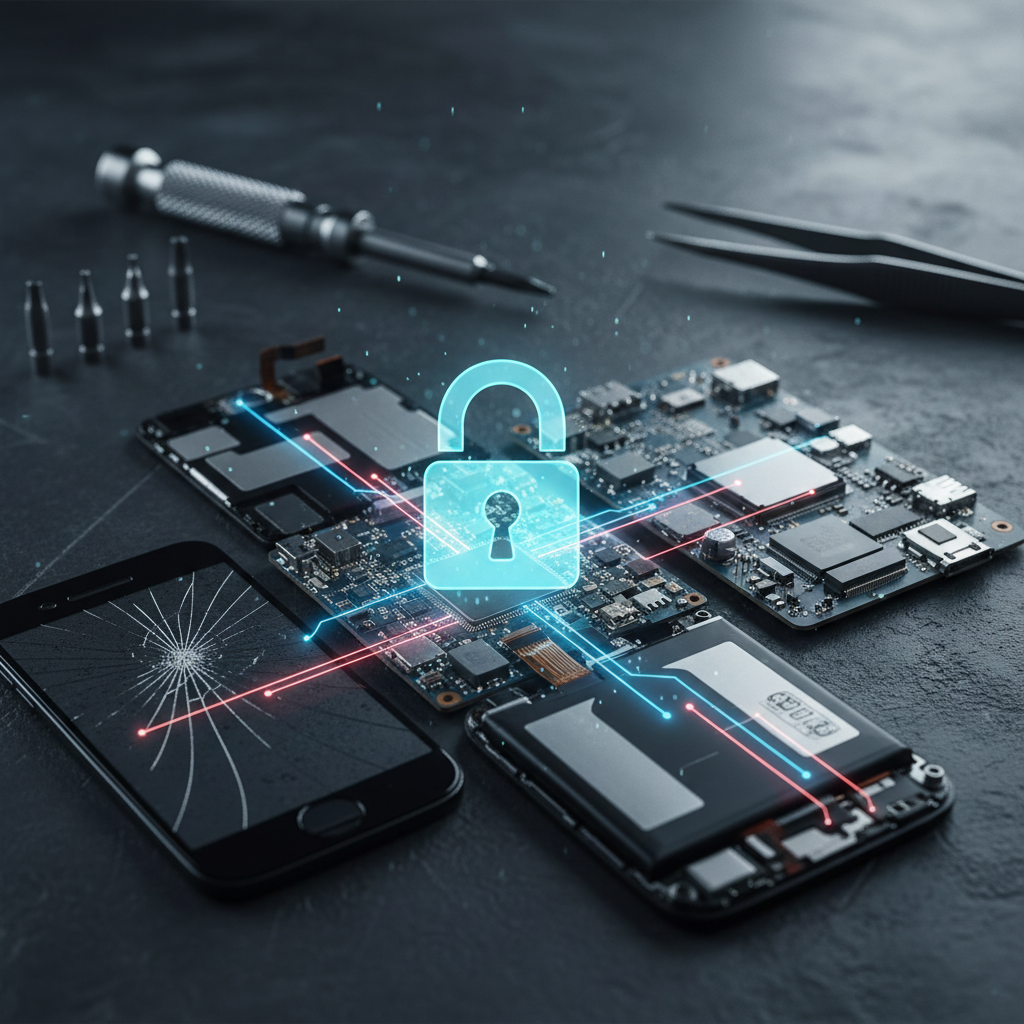
The Invisible Lock: When Hardware Becomes Software
You dropped your iPhone 15. The screen is a spiderweb of glass. A few years ago, this was a straightforward fix: you’d order a high-quality replacement panel, spend an hour with some pentalobe screwdrivers, and be back in business. Today, even if you buy two identical iPhones and swap their brand-new screens, both phones will lose critical features like FaceID or True Tone. This is the reality of parts pairing, often referred to as “serialization.”
Manufacturers have shifted the battlefield. While they’ve started making spare parts available and providing PDF manuals to satisfy regulators, they’ve introduced a digital gatekeeper. It’s no longer enough for a part to fit physically; it must be “blessed” by the manufacturer’s server. This digital handshake turns a simple hardware repair into a complex software negotiation, often leaving independent shops and DIY enthusiasts out in the cold.
The Architecture of Serialization
At its core, parts pairing works by assigning a unique serial number to individual components—the battery, the screen, the camera module, and the logic board. During boot-up, the smartphone performs a digital roll call. If the logic board detects a serial number it doesn’t recognize, it triggers a software response. This can range from annoying “non-genuine part” pop-ups to the complete deactivation of features like automatic brightness or biometric security.
Apple has been the most prominent user of this tactic. When the iPhone 13 launched, third-party screen replacements initially disabled FaceID entirely. Public outcry forced a software update to walk that back, but the precedent was set. Today, if you replace a battery in a modern iPhone without using Apple’s “System Configuration” tool—which requires a remote connection to their servers—you lose the ability to see your battery health percentage. The hardware is fine, but the software chooses to go blind.
Google and the Pixel: A Different Shade of Locked
For a long time, Google’s Pixel lineup was seen as the “pro-repair” alternative. Google partnered with iFixit to sell genuine parts and provided detailed repair guides. However, the Pixel hasn’t escaped the software-lock trend. Starting with the Pixel 6 and continuing through the Pixel 8 and 9 series, the fingerprint sensor is tied to the motherboard.
If you replace a Pixel screen, which houses the under-display fingerprint sensor, you must run a web-based “Fingerprint Sensor Calibration Tool.” While this tool is publicly available, it is notoriously finicky. It often fails to run on certain browsers or requires specific driver configurations on a PC. If the tool fails, your biometric security is dead. This creates a psychological barrier; users who might feel comfortable turning a screwdriver are terrified of “bricking” their phone’s security features with a software glitch.
The ‘Self-Repair’ Program Illusion
To appease lawmakers, manufacturers launched self-repair programs. On paper, it looks great. You can rent a 70-pound toolkit from Apple for $50 and buy a genuine battery. But the fine print reveals the trap. To complete the repair, you must initiate a “System Configuration” session with a support representative. This means you cannot use a battery salvaged from another iPhone or a high-quality third-party battery without losing functionality. The repair is only truly “complete” when the manufacturer gives you digital permission.
This creates a closed ecosystem where the manufacturer dictates the price and availability of longevity. If a company decides to stop supporting a five-year-old model, they don’t have to stop making parts—they just have to shut down the authentication server. Once that server goes dark, every spare part in existence becomes a “non-genuine” part in the eyes of the phone’s software.
The Ecological Cost of Digital Gates
The environmental impact of parts pairing is staggering. In a truly circular economy, a broken phone would be a goldmine of spare parts. If a phone has a dead motherboard but a perfect screen, that screen should be harvested to fix another device. Under the current serialization regime, that screen is effectively e-waste. When an independent repair shop tries to use a “pulled” (original but used) part, the device treats it with the same suspicion as a counterfeit component.
We are seeing thousands of perfectly functional OEM parts shredded every year because they cannot be digitally uncoupled from their original devices. This forces consumers to buy brand-new parts, which requires new mining, new manufacturing energy, and more carbon emissions for shipping. It turns the “reduce, reuse, recycle” mantra on its head, prioritizing “buy new” at every turn.
The Safety Argument: Fact or Friction?
Manufacturers argue that parts pairing is for consumer safety and security. They claim that unauthorized screens could be used to scrape touch data or that third-party batteries could explode. There is a kernel of truth here—low-quality lithium-ion batteries are indeed a fire hazard. However, the software locks don’t just block dangerous parts; they block all parts that aren’t sold through their specific retail channel.
If the goal were truly safety, the phone could display a simple warning: “This battery is not verified.” Instead, they disable features completely. There is no technical reason why a screen replacement should disable an ambient light sensor or why a camera module replacement should result in a shaky video because OIS (Optical Image Stabilization) was software-disabled. These aren’t safety measures; they are market controls.
The Legal Battle: Oregon’s Big Win
The tide is beginning to turn, but the legislative process is slow. In early 2024, Oregon passed a landmark Right to Repair law that specifically bans parts pairing. This is the first law of its kind to tackle the software-locking issue head-on. It mandates that manufacturers cannot use software to discourage repair or prevent the use of non-original parts.
The ripple effects of this law could be massive. Because it is expensive for tech giants to create different hardware versions for different states, a win in Oregon often dictates the standard for the entire United States. However, companies are fighting back. During the hearings, lobbyists argued that such laws would compromise the “integrity” of the devices. For the consumer, “integrity” usually feels like a synonym for “monopoly.”
Why Independent Shops are Closing
For decades, local repair shops were the backbone of device longevity. They offered cheaper, faster alternatives to the Genius Bar. Parts pairing is slowly suffocating these businesses. When a shop has to explain to a customer that their $150 repair will result in an “Unknown Part” warning and the loss of their FaceID, the customer naturally blames the shop, not the manufacturer.
This creates a “race to the bottom.” Independent technicians are forced to perform “chip transfers,” where they desolder the tiny IC (integrated circuit) chip from the original broken screen and solder it onto the new screen. This is high-level microsoldery that requires expensive equipment and hours of labor. It shouldn’t be necessary just to swap a display, and it makes the repair too expensive for the average consumer to justify.
How to Buy for Repairability
If you’re tired of the pairing trap, your options are limited but growing. The Fairphone remains the gold standard for repairability, with no software locks and a modular design, though its availability in the U.S. is limited. For mainstream users, look for companies that provide open-source calibration tools or those that have publicly committed to reducing serialization.
Before purchasing your next flagship, check the iFixit repairability score. These scores now account for software hurdles, not just how many screws you have to remove. A phone that gets a 9/10 for hardware but a 3/10 for software is effectively a 3/10 for the average person. Supporting brands that respect your right to own—and fix—your hardware is the only way to shift the market.
The Future: Will We Ever Truly Own Our Phones?
The concept of ownership is becoming increasingly blurred. When you buy a phone today, you are essentially buying a hardware license that the manufacturer can revoke or restrict at will. If you can’t fix it, you don’t really own it. The ‘Parts Pairing’ trap is the final wall in the “walled garden” strategy, designed to keep you on a two-year upgrade cycle regardless of how well the physical device is holding up.
To break this cycle, we need more than just tools and manuals. We need a fundamental shift in how we view electronics. Your smartphone shouldn’t be a disposable appliance; it should be a tool that lasts a decade. As long as software locks remain legal, the “Right to Repair” will remain a hollow promise, leaving us trapped in a loop of forced obsolescence and unnecessary electronic waste. The hardware is ready to last; it’s the software that’s holding it back.
Frequently asked questions
What is parts pairing?
Parts pairing is a software mechanism where a device’s internal components are digitally locked to the motherboard using unique serial numbers. If you replace a part, the system detects a mismatch and may disable features or show warning messages, even if the new part is genuine.
Which companies use parts pairing?
Apple is often cited as the pioneer of this practice, using it for everything from screens and batteries to FaceID sensors. However, Google and Samsung have also implemented similar software checks in their newer flagship models, often requiring recalibration software to complete a repair.
Can I still repair my iPhone with third-party parts?
Technically, yes, but with major catches. You might lose features like True Tone, FaceID, or high-definition camera functionality. You will also likely receive persistent ‘Important Message’ notifications on your lock screen stating that the part cannot be verified.
Is parts pairing illegal?
Recent legislation in states like Oregon and California has begun to ban parts pairing. These laws aim to ensure that manufacturers cannot use software locks to prevent the use of independent or used parts, though the full implementation of these rules will take time.