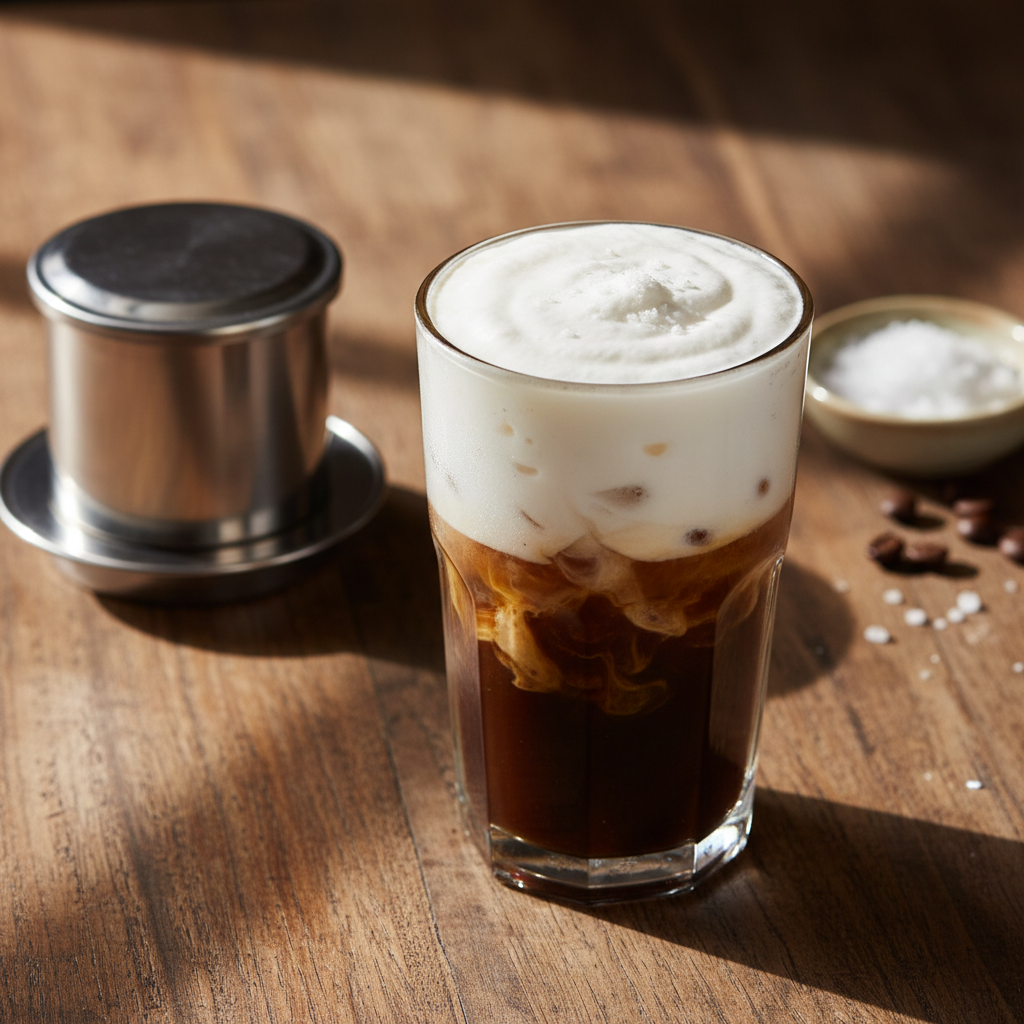
The Rise of the Savory Caffeine Kick
If you have spent any time on social media lately, you have likely seen a dark, rich coffee topped with a thick, snowy layer of cream. This isn’t your standard Starbucks cold foam. This is Vietnamese Salt Coffee, or Cà Phê Muối. Originating in the historic city of Huế, this drink has traveled from humble street stalls to high-end boutiques in Saigon, London, and New York. It is a masterclass in flavor balancing: bitterness from dark-roasted beans, sweetness from condensed milk, and a surprising savory punch from salted cream.
Most people assume they need professional-grade espresso machines or specialized culinary training to replicate this at home. They are wrong. Recreating this trend is about technique and ratio, not expensive hardware. While you might use best online tools to find local cafes serving this treat, making it yourself costs pennies and tastes significantly better because you control the salt-to-sugar equilibrium.
The Anatomy of Salt Coffee
To get the perfect salty cream top, you first need to understand what makes it distinct from a latte or a macchiato. Vietnamese coffee is fundamentally different because of the beans and the brewing method. Most Vietnamese coffee uses Robusta beans, which contain almost double the caffeine of Arabica and have a deep, earthy, almost chocolatey profile. When you brew this through a Phin—the traditional gravity-fed metal filter—you get a concentrate that is thick enough to support a heavy cream topper.
The “Salty Cream” is the star of the show. It is essentially a stabilized cold foam. Unlike the airy, bubbly milk foam on a cappuccino, this is dense, velvety, and holds its shape. Think of it as a pourable cheesecake layer that sits atop your caffeine. When you take a sip, the salt hits your tongue first, which actually enhances the sweetness of the condensed milk and dampens the bitterness of the coffee. It’s a trick used by pastry chefs for decades, now applied to your morning cup.
Essential Tools and Ingredients
- The Phin Filter: A small, stainless steel gravity dripper. It requires no paper filters and produces a slow, steady drip.
- Vietnamese Coffee Grounds: Look for brands like Trung Nguyen or Cafè Du Monde (the latter is a New Orleans staple often used by the Vietnamese diaspora).
- Sweetened Condensed Milk: This provides the body and sugar. Longevity Brand is a gold standard here.
- Heavy Whipping Cream: Do not use half-and-half; it won’t hold the air required for the thick “cap.”
- Fine Sea Salt: This dissolves quickly without leaving a gritty texture.
Mastering the Salty Cream Foam
This is where most home baristas fail. They either over-whip the cream into butter or under-whip it into a runny mess that disappears into the coffee. You want a consistency similar to Greek yogurt or soft-serve ice cream before it melts. If you’re documenting your process for a blog or social media, you might look for useful websites list to see the exact visual cues of the “soft peak” stage.
The Secret Ratio
To get that high-end cafe finish, use 100ml of heavy whipping cream, 15ml of condensed milk, and a generous 1/4 teaspoon of fine sea salt. Whisk these together using a hand frother or a small electric mixer for about 30 to 45 seconds. You are looking for a “slow pour.” When you lift the whisk, the cream should trail down in a thick ribbon and sit on the surface of the liquid for several seconds before merging.
If you find that your foam is too salty, add a teaspoon of whole milk to thin it out and dilute the salt. If it isn’t salty enough, the coffee will just taste like a standard latte. The salt should be assertive enough that you notice it immediately, forcing your brain to anticipate the sweet coffee underneath.
Brewing the Perfect Base
A salty cream top on watery coffee is a disaster. You need a base that can fight back. To brew with a Phin, follow these steps:
- Add 3 tablespoons of coffee to the Phin.
- Place the internal press lightly on top (don’t tamp it too hard, or the water won’t pass through).
- Pour a tiny bit of boiling water (about 200°F) just to moisten the grounds. Let them bloom for 30 seconds.
- Fill the Phin to the top with water and place the lid on.
- Wait. The drip should be slow—roughly 4-5 minutes for the full cycle. If it flows through in a minute, your grind is too coarse. If it takes 10 minutes, your grind is too fine or the press is too tight.
While the coffee drips, put 1-2 tablespoons of condensed milk into your glass. As the hot coffee hits the milk, it creates a thick, dark syrup. Stir this vigorously before adding ice. If you are a student or a busy professional, you might use online tools for students to manage your schedule, but don’t rush this drip process. The slow extraction is what gives the coffee its “motor oil” consistency that is essential for the salt coffee experience.
Advanced Variations: Scallion Oil and Beyond
The “Salty” trend in Asia isn’t limited to just salt. Some specialty shops have begun introducing “Scallion Oil Coffee” (Hành Phi). While it sounds bizarre, it follows the same logic as Salt Coffee: savory fats enhancing sweet beverages. To try this at home, you briefly sauté finely chopped scallions in a neutral oil, then drizzle a tiny amount of that flavored oil over the salty cream. The aroma adds an incredible savory depth that mimics the experience of eating a high-end salted caramel dessert.
Another variation involves using “Cheese Foam,” popular in bubble tea shops. This uses cream cheese blended with the salty cream. This adds a tanginess that cuts through the richness of the condensed milk. If you are running a small cafe or looking for online tools for business to market your food creations, these unique variations are what drive viral engagement on platforms like TikTok and Instagram.
Troubleshooting Common Mistakes
The Cream Sinks Immediately: This happens if your coffee is too hot or your cream is too thin. Ensure you have plenty of ice in the glass to create a cold barrier, and whip your cream until it carries more air. The density of the cream must be lower than the density of the iced coffee.
The Salt is Gritty: This usually occurs when using Kosher salt or coarse sea salt. If you only have coarse salt, dissolve it in a teaspoon of hot water before adding it to the heavy cream. This ensures every sip is uniform.
The Coffee is Sour: Sourness in coffee usually indicates under-extraction. Ensure your water is hot enough (just off the boil) and that you are using a dark enough roast. Vietnamese coffee should never be bright or acidic; it should be bitter, nutty, and bold.
Building the “Instagrammable” Layer
Presentation is 50% of the experience with Salt Coffee. To get that perfect horizontal line between the dark coffee and white cream, pour the cream over the back of a spoon. Hold the spoon just above the coffee’s surface and pour slowly. This breaks the fall of the cream and allows it to spread out across the surface rather than plunging to the bottom. It creates a striking visual contrast that is the hallmark of professional Asian coffee chains.
Sustainability and Cost Savings
A single Salt Coffee at a boutique shop in a major city can cost anywhere from $7 to $9. By making it at home, you reduce that cost to about $0.60 per serving. Furthermore, you eliminate the plastic waste associated with take-out cups. Using a Phin filter is one of the most eco-friendly ways to brew, as there are no paper filters to throw away and no plastic pods to recycle. It is a win for your wallet and the planet.
Whether you are using best websites for daily use to find new bean varieties or just looking to spice up your morning routine, mastering Vietnamese Salt Coffee is a rewarding skill. It challenges your palate and introduces a level of culinary sophistication to a simple caffeine fix. Once you get the hang of the salty cream top, you’ll find it hard to go back to a plain latte ever again.
The beauty of this trend lies in its accessibility. You don’t need a $2,000 espresso machine. You need a $5 metal filter, some heavy cream, and the patience to let the coffee drip slowly. The result is a drink that is textural, complex, and deeply satisfying. It represents a bridge between traditional Vietnamese coffee culture and modern global flavor trends, proving that a little bit of salt can transform the most mundane ingredients into something extraordinary.
Frequently asked questions
Why do I need to use Vietnamese coffee beans?
Traditional Vietnamese coffee uses Robusta beans, which are bolder and more bitter than Arabica. This strength is necessary to stand up against the richness of the salty cream and condensed milk.
Can I use milk instead of heavy cream for the foam?
Heavy whipping cream is essential for the structure. Half-and-half or milk will not whip into the thick, cloud-like peaks required for the authentic layers.
What kind of salt should I use?
Fine sea salt or pink Himalayan salt is best. Avoid coarse salt, as it won’t dissolve properly in the cream and will create a gritty texture.
Can I make this without a Phin filter?
Yes, you can use a French press or an Aeropress to make a concentrated brew, though the flavor profile will differ slightly from the traditional gravity-fed Phin filter.
Do I need expensive equipment to make the foam?
Absolutely. You can whisk the cream by hand or use an electric milk frother. However, a hand mixer or a small electric whisk provides the most consistent, velvety results quickly.