It is actually kind of wild when you think about it.
You walk into a building that has stood in the heart of Rome for nearly two thousand years, and it’s basically just a big, empty room.
No altar, no real throne, just a massive space that feels like it swallows the sky.
The Pantheon is one of those places that just does everything right. Now think about that for a second.
It’s old, it’s huge, and it’s still full of people every single day.
From what I’ve seen, most tourists rush past it to get to the Trevi Fountain, which is a shame because this place holds the secret to Roman engineering that we’re still trying to figure out today.
The Secret Behind the Name
Most people just call it the Pantheon, which comes from the Greek word pan (all) and theon (god).
Basically, it means “All the Gods.” That was the idea back in 27 BC when Marcus Agrippa built the original temple, right after Augustus took power.
But here is where it gets weird.
That building? It burned down.
Twice, actually.
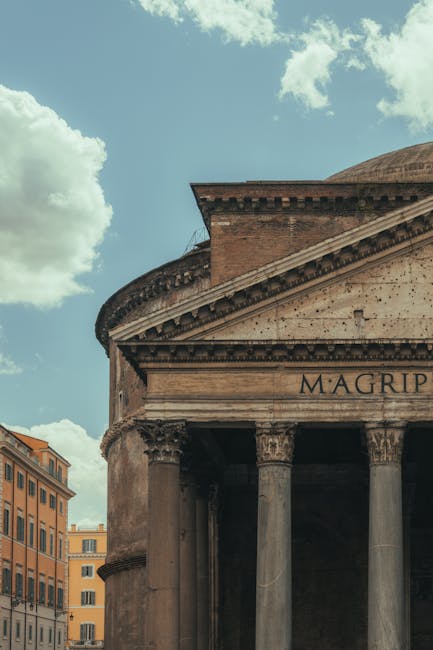
Then, in 118 AD, Emperor Hadrian rebuilt it. But there’s a catch.
The crazy thing is, he didn’t put his name on the front.
He left Agrippa’s inscription there.
So for centuries, people thought Agrippa had built the one we see today, even though Hadrian was the real genius behind it.
It’s a little ego boost for the guy who fixed the mess, right?
The Engineering Miracle (That You Can Actually See)
If you want to see true engineering, look up.
The Pantheon’s dome is the largest unreinforced concrete dome in the entire world. Here’s the interesting part.
That means it doesn’t have steel bars holding it up; it’s just the concrete itself.
The Romans were total pros at this.
They figured out that if you use a lighter aggregate at the top—like pumice—and heavier stuff at the bottom, the dome won’t collapse under its own weight.
- The Oculus: There’s a hole in the center of the dome, about 30 feet wide.
It lets light pour in and, honestly, it’s the best part of the visit.
It’s not just for show.
It also acted as a drainage system when it rained.
- The Cornice: The dome curves inward at the top to make the concrete lighter.
You can barely see it, but it’s there.
It’s like a subtle hint to gravity: “Okay, you can let go now.”
Now think about that for a second.
A Living Church, Not Just a Museum
It wasn’t always a museum.
After the fall of Rome, the Pantheon was converted into a church in 609 AD.
Pope Boniface IV gave it a new purpose: a church dedicated to St.
Mary and all the martyrs.
That’s why it’s still a church today.
There are weddings happening here every single week.
You’ll see tourists trying to take photos, but you also see couples in suits and dresses just soaking in the atmosphere.
It’s a pretty surreal mix of history and modern life.
Most people overlook this duality, but it’s what gives the building its soul.
Practical Guide: How to Actually Enjoy It
Okay, let’s be real.
The Pantheon is crowded. Now think about that for a second.
Like, really crowded.
If you go at 9 AM on a Saturday, you’re going to be shoulder-to-shoulder with everyone in Italy.
You can pay to skip the line, but honestly, standing in line for 45 minutes just to walk into a big room isn’t always worth it if you’re just going to be stuck behind a group of Japanese tourists taking selfies.
But if you get in early, you can really appreciate the scale.
It feels like you’re inside a bottle.
- Best Time: I recommend going right when they open at 9:00 AM or right before they close at 7:30 PM.
The midday crowds are just too much.
- Admission: It’s free, but you have to book a time slot online sometimes.
Check the official site to be safe.
- Dress Code: It is still a church, so cover your shoulders and knees.
It’s not super strict, but respect goes a long way.
And this is where things get interesting.
What’s Next in Rome?
If you’re using the Pantheon as a base for your Roman holiday, you can’t go wrong with the surrounding area.
It’s smack dab in the historic center.
Just a short walk away, you’ll find the Zoe Kravitz: More Than Just The Cat That Purred in Batman“>best gelato in Rome (trust me, you’ll need it).
Or, if you’re into the hardcore ancient stuff, the Roman Forum is only a 10-minute walk down the road.
It’s the kind of place that makes you feel like Indiana Jones, but without the snakes.
Final Thoughts
I think the Pantheon survives because it’s humble.
It doesn’t try to be flashy like the Colosseum. But there’s a catch.
It’s just a really, really good room.
The way the light hits the floor changes throughout the day, and it feels like the building is breathing.
Whether you’re into history, architecture, or just need a quiet place to escape the heat, it delivers.
Just make sure you leave some space in your camera roll.
You’re gonna want pictures of that hole in the roof.
Image source: pexels.com
Oddly enough,
Image source credit: pexels.com