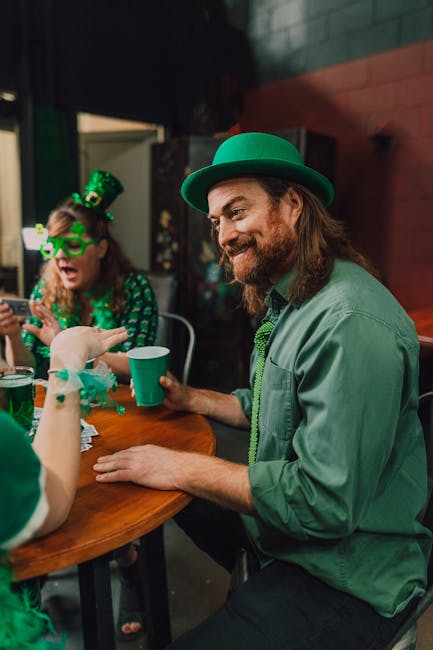
And let’s be honest, if you’re not wearing green today, you’re probably going to get pinched by someone who thinks it’s hilarious.
It’s that time of year again.
The entire world turns green. Oddly enough,
You see it on street signs, on Starbucks cups, and on people who definitely do not have a drop of Irish blood in their veins.
But have you ever stopped to wonder where this madness actually came from? Is it really about the luck of the Irish, or is it just an excuse for a giant party? Turns out, the history is a lot messier and way more interesting than the stories we tell at the bar.
So, we are diving into the deep end of the holiday pool today.
We are going to look at the guy named Patrick, the snakes that didn’t exist, and the corned beef that is actually Jewish.
It’s a wild ride through history, superstition, and a whole lot of alcohol.
Who Was This Guy, Really?
When you think of St.
Patrick, you probably picture a bearded man in green robes handing out shamrocks to crowds.
But the real story is way grittier.
He wasn’t born in Ireland.
In fact, he wasn’t even Patrick at first.
His birth name was Maewyn Succat. Oddly enough,
He was born somewhere in Roman Britain, probably around the late fourth century.
Now, here is where it gets dramatic.
When he was sixteen, a group of pirates raided his family’s estate and kidnapped him, dragging him all the way to Ireland to be a slave.
He was forced to work as a shepherd for six years out in the middle of nowhere.
It was lonely, cold, and terrifying.
He actually turned to religion during this time because he was desperate for comfort.
He prayed almost constantly, even though he had rejected God as a kid.
Eventually, he escaped.
He walked about 200 miles back to the coast, hopped on a boat, and went back home.
But he didn’t stay there.
He had a vision telling him to go back to Ireland and convert the people there to Christianity. Here’s the interesting part.
So, he went back.
Not as a conqueror, but as a missionary.
He studied for twelve years in a monastery before he started his work.
He wasn’t exactly a saint in the fairy-tale sense; he was a guy who survived slavery and came back to try and save souls.
It’s kind of inspiring if you think about it.
The Legend of the Snakes
There is a very popular story that St. Now think about that for a second.
Patrick drove all the snakes out of Ireland.
And you know what? It’s total fiction.
Ireland is an island that was never connected to the mainland, so there were never any snakes there to begin with.
What the story actually refers to is the expulsion of pagan symbols and “druids” from the country.
The snakes were just a metaphor for the pagans he was converting.
It’s a great story, but it’s just not true.
Nature doesn’t work like that, and neither does geology.
Shamrocks, Leprechauns, and Sham Magic
So, what about the symbols? The most famous one is the shamrock.
St.
Patrick used the three-leaf clover to explain the Holy Trinity to the pagan Irish. But there’s a catch.
One leaf for the Father, one for the Son, and one for the Holy Spirit.
Simple, right? But the leprechaun? That’s a whole different story.
Most people picture the cute, little cartoon leprechaun from the movies. Now think about that for a second.
You know, the one wearing a green coat and a tall hat who sits at the end of a rainbow guarding a pot of gold.
But in old Irish folklore, the leprechaun was a completely different creature.
They were actually grumpy, solitary little men who made shoes.
They were known for being mischievous and sometimes cruel, not the cuddly tricksters we see today.
They didn’t guard gold; they made magical boots that let you run faster.
The modern version is a product of American marketing, plain and simple.
It’s the same thing that happened to Santa Claus, really.
The Food We Eat is Not Irish
If you are sitting down to dinner tonight, you might want to check your plate.
I know, it’s harsh news, but you might be eating Jewish food.
The traditional dish for St.
Patrick’s Day in Ireland is actually bacon and cabbage.
Yes, bacon.
American corned beef and cabbage? That is a distinctly American invention.
Irish immigrants in New York City in the 19th century couldn’t afford beef, which was expensive in America.
So, they switched to corned beef, which was cheap and available at Jewish delis. And this is where things get interesting.
They smoked it and served it with cabbage.
It was a delicious accident born of poverty.
Now, we have made it a tradition.
It’s funny how our traditions are just the result of someone being broke and finding a workaround.
The First Parade Was in America
Here is another fun fact that surprises almost everyone.
The very first St.
Patrick’s Day parade wasn’t in Dublin, Ireland.
It was in New York City. Oddly enough,
In 1762, a group of Irish soldiers serving in the British Army marched through the streets of New York to celebrate their heritage. Here’s the interesting part.
It was a way for them to connect with their roots in a place that didn’t really understand them.
The parade grew and grew over the years, becoming the massive event it is today.
Ireland didn’t even hold a St.
Patrick’s Day parade until the 20th century.
So, really, the United States owns the party aspect of this holiday.
Modern Day Hype and Green Beer
Today, the holiday has basically become a celebration of drinking.
I’m not saying I’m not guilty of it myself.
Green beer is fun, even if it tastes like liquid food coloring and sadness.
But we have turned this religious holiday into a party.
It’s a celebration of Irish-American culture, which is a huge part of our national identity.
Some people get annoyed by this.
They say we are disrespecting the history of the holiday.
Others say, hey, it’s just a party.
We should celebrate the fact that people survived slavery and went back to save their oppressors.
It’s a complicated history.
But for one day, the world turns green.
We all share a little bit of luck, even if we are just drinking cheap beer at a sports bar.
- St.
Patrick was not born in Ireland.
- The snakes were never in Ireland.
- Corned beef is actually Jewish-inspired.
- The first parade was in New York.
- Leprechauns are grumpy, not cute.
It’s kind of funny how much we remember and how much we forget.
But I think that is the beauty of holidays. And this is where things get interesting.
They are a mix of fact and fiction, history and myth.
We tell the stories that make us feel good, and we ignore the parts that are too messy.
As long as we are enjoying the day with friends and family, I guess the history doesn’t matter that much. Now think about that for a second.
At the end of the day, it’s about the community.
It’s about putting aside the stress of the work week and just being silly for a few hours.
Whether you are Irish, or you just wish you were, we are all just celebrating the idea of spring coming. Now think about that for a second.
The cold is ending, the days are getting longer, and there is a pot of gold waiting for us all if we just look for it.
Photo Credit: pexels.com
Image source credit: pexels.com