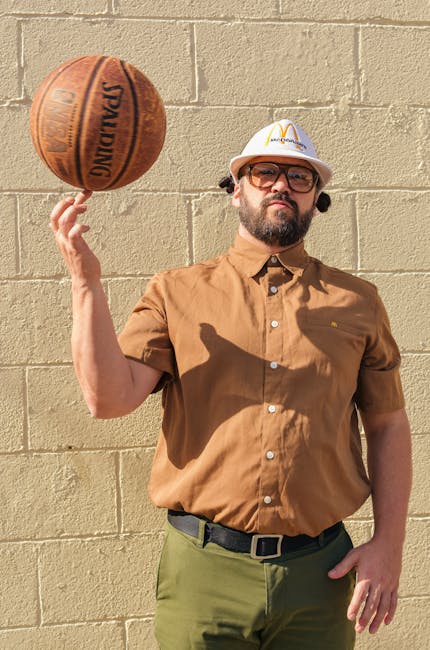
So, you watch a game of basketball and think, “This is just a sport.” But if you look back a little bit—like, to 1891—you realize that the game as we know it basically didn’t exist.
That’s because James Naismith decided he was tired of kids freezing outside in the snow and decided to throw a soccer ball into peach baskets.
I mean, peach baskets! That’s how it started.
From what I’ve seen while digging into sports history, Naismith wasn’t just a guy with a clipboard.
He was a priest, a doctor, a teacher, and a coach all wrapped up in one.
He didn’t set out to create a multi-billion dollar industry; he just wanted to keep students active during a brutal New England winter.
But his invention? Yeah, that thing took on a life of its own.
The Winter of 1891: A Game Born of Necessity
Okay, let’s set the scene.
It’s cold.
Really cold. But there’s a catch.
Dr.
Luther Gulick, the head of physical education at the International YMCA Training School in Springfield, Massachusetts, was frustrated.
The students were getting restless, and outdoor activities were basically impossible. Now think about that for a second.
Gulick gave Naismith a challenge: come up with a game that can be played indoors, doesn’t require a lot of equipment, and keeps kids safe from rough physical contact.
Naismith thought about his childhood.
There was a game called Duck on a Rock he used to play in Canada.
You threw a rock at a big stone to knock the big stone off a perch.
Simple physics, but fun.
He thought about that concept but applied it to a ball.
He wrote up 13 rules on a piece of paper and posted them on a bulletin board.
That paper? It’s probably the most important document in sports history, even if nobody realized it at the time.
The 13 Original Rules (They’re Actually Pretty Wild)
But there’s a catch.
If you look at the Kansas Jayhawks Basketball: The Soul of Phog Allen“>original 13 rules of basketball, you’re going to be confused.
Modern players would be calling a ref every 30 seconds.
- There were no dribbles! You had to pass the ball with your hands.
If you ran with it, you’d get called for a traveling violation.
- Throwing the ball into the peach baskets ended the possession.
But here’s the kicker: they didn’t cut the bottoms out of the baskets.
A janitor had to climb a ladder every time someone scored.
Imagine trying to guard a shooter when the scorer is standing right there.
- There were only nine players per side.
That’s it.
No full courts, just basically a half-court setup.
- Fouls were different, too.
You didn’t get free throws.
If you fouled someone, you just handed them the ball again.
Honestly, it sounds like a pick-up game gone wrong, but it worked.
The students loved it.
They kept playing late into the night, and basketball was born.
Beyond the Court: Who Was He Really?
Most people think of Naismith as a coach.
That’s fair, he did coach for years.
But he was a complex guy.
He was born in Canada, an orphan really early in life, which gave him a bit of a rugged background.
He studied medicine, which makes sense given how physical the game got.
He spent a lot of his life at the YMCA.
It’s funny how the organization that helped spread basketball globally was also the place where the game was invented.
He was a devout Presbyterian minister, too.
He believed that physical education was a moral duty.
It wasn’t just about getting fit; it was about building character.
A Life of Service
When he moved to Kansas, he became a physical education teacher and the school’s athletic director.
He also coached the football team for a bit (which, weirdly, he hated doing).
He eventually got a PhD in Philosophy.
Here’s the interesting part.
People forget this, but Naismith actually wanted to be a Presbyterian minister.
He worked as a YMCA secretary for a long time before ever really coaching seriously.
So, when you see him on a statue, remember: he was a scholar and a man of the cloth first, a coach second.
The Naismith Memorial Basketball Hall of Fame
By the time he passed away in 1939, basketball had spread all over the world.
The game he created was huge.
In 1959, the Hall of Fame was founded in his hometown of Springfield.
It was renamed the Naismith Memorial Basketball Hall of Fame in 1973.
It’s located right next to the basketball court where he hung those first peach baskets. Now think about that for a second.
It’s a fitting tribute, but honestly, it probably gets more attention than the man deserves.
He’s often overshadowed by the legends who played the game he invented.
But without him, those legends wouldn’t exist.
But there’s a catch.
The Legacy That Keeps On Giving
Naismith didn’t make money off basketball.
He never patented it.
He believed the game should be for everyone.
There’s a famous quote where he said, “The game is designed to teach character, self-control, and sportsmanship.” It sounds like a cliché you’d hear at a pep rally, but for him, it was serious business.
Even now, there’s a rule called the Naismith Rule in youth basketball.
It basically says you can’t push off, hit, or move a defender illegally.
It’s his direct influence on the sport’s safety.
So, the next time you’re watching the NBA or playing pickup at the park, take a second to think about the guy who stood on that second floor of the YMCA with a ladder and a soccer ball.
He didn’t just create a sport; he created a global community.
Why You Should Read More
If you’re interested in the deep history, there are a few biographies that go into detail about his life.
One of the best options I’ve found is “Dr.
Naismith’s Game: The Birth of Basketball”.
It really breaks down the psychology behind the rules and his personal struggles.
It’s not just a dry history book; it reads like a story about a guy trying to do the right thing in a difficult situation.
Also, if you ever get a chance to visit Springfield, you should go.
The Hall of Fame is great, but the history of the YMCA itself is fascinating.
It really shows how a simple idea can grow into something massive.
But there’s a catch.
Image source: pexels.com
Image source credit: pexels.com