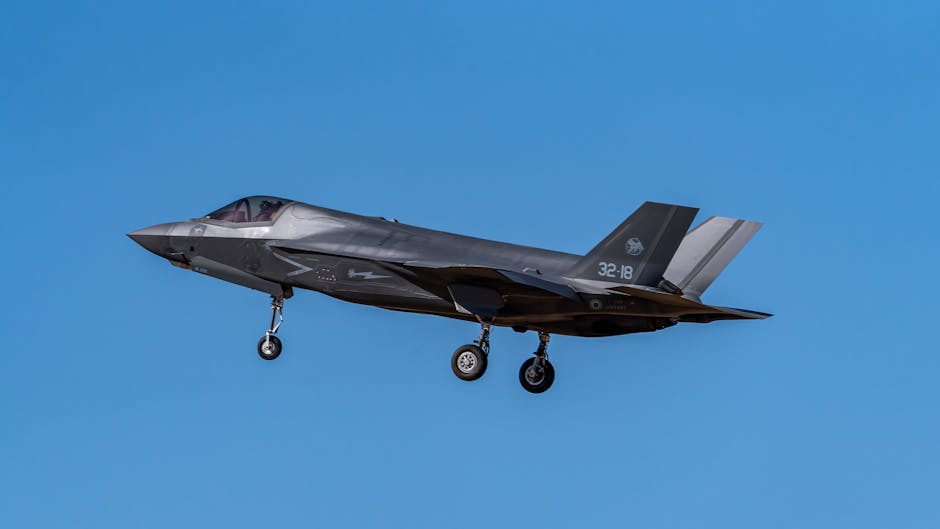
It always happens.
Someone posts a grainy, black-and-white video of a plane going down in the Middle East or Eastern Europe.
The caption reads something like, ‘F-35 shot down by S-400.’ Immediately, the internet explodes.
You have the F-35 die-hards screaming that it’s impossible, and the skeptics saying, ‘See? Stealth is dead.’
But here is the thing most people overlook. Here’s the interesting part.
The idea that a $100 million plane is invisible is a myth.
From what I’ve seen in the defense community, ‘stealth’ is less about being a ghost and more about reducing your chances of getting hit.
If we are talking about the f-35 shot down incidents, we need to look past the headlines and understand the reality of low observability.
Is the F-35 Actually Impossible to Hit?
First, let’s get the bad news out of the way.
No airplane is truly invisible.
That’s just physics.
The F-35 is a fifth-generation fighter, which means its main goal is to have a very small radar cross-section (RCS).
It bends radar waves away so they don’t bounce back.
However, stealth isn’t a permanent cloak.
It fades.
Over time, the coating wears off.
Also, stealth geometry only works from certain angles.
If you are behind the plane or above it, you can see it just fine.
And let’s not forget infrared (heat) sensors.
An F-35 produces a massive amount of heat from its engines, especially when afterburning.
That’s like a giant flashlight in the dark for heat-seeking missiles.
The Problem with ‘Low Observable’
Most people overlook how complex these jets are.
The F-35 is designed to survive in a heavily defended airspace.
But ‘survive’ doesn’t mean ‘invincible.’ It means the odds are heavily stacked in your favor.
When people ask, how to shoot down an f35, the answer is rarely ‘aim a radar at it.’ It’s usually MANPADS (Man-Portable Air-Defense Systems) or older, non-stealth-specific radar systems that rely on trajectory prediction.
Recent Incidents: What Really Happened?
Let’s look at the claims.
In 2018, there was a report about an F-35 crashing in Iraq.
Then there are the frequent reports from Syria.
In these conflicts, air defenses are everywhere.
It’s not just a big S-400 battery; it’s thousands of small, cheap SA-7s and Igla missiles.
- The Syria Incident (2018): Reports claimed an F-35 was hit by ground fire.
While official sources were vague, experts suggest it might have been a lucky shot by a shoulder-fired missile rather than a sophisticated radar kill.
- The Low-Altitude Threat: The F-35 is designed to fly fast and low.
But that puts it right in the range of shoulder-fired missiles.
It’s a trade-off.
You give up some protection at ultra-low altitudes to survive medium altitude.
Can an S-400 Really Shoot Down an F-35?
This is the big one.
Russia loves to claim they can shoot down anything.
The S-400 Triumf is a beast of a system.
It has long-range missiles and active protection. Now think about that for a second.
But here is the kicker: it has a very short reaction time at low altitudes.
The F-35’s advantage is agility and speed.
If it detects the S-400 radar emissions (which are hard to hide), it can use its EOTS (Electro-Optical Targeting System) to look for the launch plume of the missile before the radar even locks on.
By the time the missile leaves the tube, the F-35 might already be banking or dropping a decoy.
The Real Vulnerability: The Pilot and The Software
Let’s talk about something else that gets people shot down. But there’s a catch.
The sensors.
The F-35 relies on datalinks.
It shows everyone on the network where it is.
If a plane is broadcasting its position to the whole team, it becomes a target.
And if the pilot makes a mistake—like flying too slow or too low, or flying through clouds where stealth is useless—they become easy meat.
Most F-35 losses in real-world scenarios aren’t due to being ‘discovered’ by radar.
They are usually due to bad piloting decisions or mechanical failures.
How to Protect Against Ground Fire
If you are flying these things, how do you stay alive? It’s not magic.
- AWACS Support: You need eyes in the sky telling you where the batteries are.
- Electronic Warfare (EW): Using jamming to blind the radar lock-on.
- Decoys: Dropping flares and chaff to confuse heat-seekers.
- Situational Awareness: Don’t fly predictable patterns.
Runway approach is the most dangerous part of the flight.
Comparison: F-35 vs F-22 vs Su-57
Is the F-35 the only one with this problem? No.
But it is the most controversial.
The F-22 Raptor is still considered better in pure air-to-air combat, partly because of its engine placement (less heat signature) and lower radar return.
The Russian Su-57 has advanced engines, but its radar systems are still catching up to the West.
The F-35 wins on sensors and networking, not just stealth.
It can see the missile launch before you even see the missile.
The Bottom Line
So, did an F-35 get shot down? Probably.
Has the F-35 proven to be invincible? Absolutely not.
The F-35 is a complex, high-tech machine, but it is still vulnerable to modern air defenses.
The best defense isn’t invisibility; it’s information and speed.
If you are looking to get into this world, whether for research or just a hobby, don’t just read the headlines.
Look at the specs and the physics.
Speaking of hobbies, if you ever wanted to experience the cockpit of a jet like this without the risk of getting shot down, checking out modern flight simulators is actually a pretty good way to start.
They have gotten really good at simulating the sensor fusion and the feel of the controls.
Final Thoughts
The narrative that the F-35 is ‘invincible’ is dangerous.
It breeds complacency.
The narrative that it’s ‘weak’ is also wrong.
It’s just a machine that trades off one risk for another.
And that’s exactly how air combat has always worked.
Image source: pexels.com
Image source credit: pexels.com