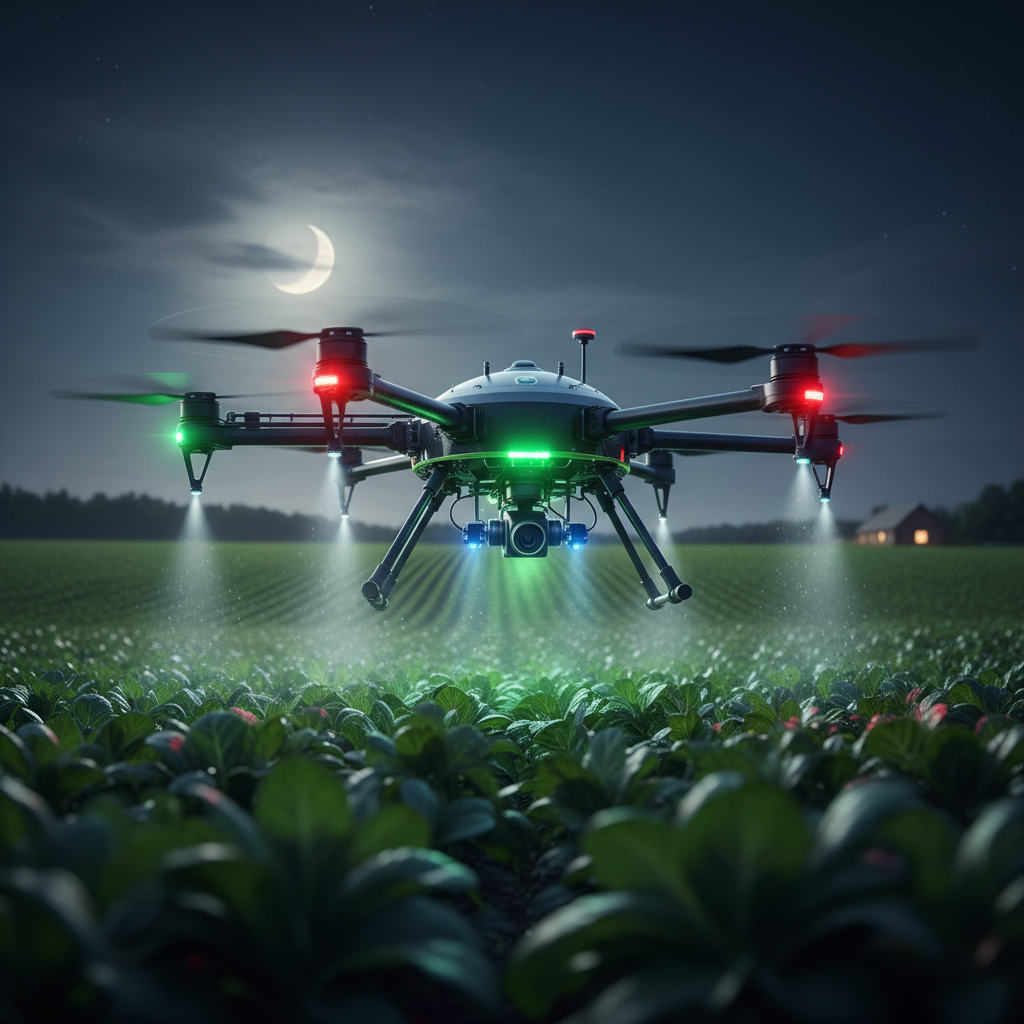
The Shift Toward After-Dark Agriculture
Walk through a rural landscape in the Midwest or the coastal plains of Southeast Asia at 2:00 AM, and you might hear a low, rhythmic hum. It isn’t a distant tractor or a passing truck. It is the sound of a hexacopter slicing through the cool night air. Agricultural drones have moved past the “novelty” phase; they are now essential workers on modern farms. Increasingly, those workers are pulling the graveyard shift.
The logic behind spraying crops at night isn’t just about fitting more work into a 24-hour window. It is rooted in chemistry, biology, and economics. For decades, traditional crop dusters (manned planes) avoided night flights because of the extreme risk of crashing into power lines or trees. But drones are different. They don’t rely on a pilot’s eyes inside a cockpit; they rely on a suite of sensors that often work better in the dark than they do in the blinding glare of the afternoon sun.
Why the Night is Better for Crop Health
Chemical efficacy is the primary driver for this nocturnal shift. When you spray a pesticide or fungicide during a hot, breezy afternoon, a significant portion of that expensive liquid never reaches the target. It either evaporates into the dry air or drifts into the neighbor’s field.
At night, the atmosphere stabilizes. We often see a phenomenon called temperature inversion, where a layer of cool air is trapped near the ground. While this requires careful management to prevent long-distance drift, the generally higher humidity at night keeps the spray droplets liquid for longer. This gives the plant more time to absorb the nutrients or medicine. According to research from organizations like the USDA Agricultural Research Service, droplet size and environmental conditions are the two biggest factors in application success. Night provides a more controlled environment for both.
Protecting the Pollinators
Bees are the silent partners of the global food supply. Spraying during the day puts these pollinators at direct risk. By the time the sun goes down, most beneficial insects have returned to their hives or nests. Applying treatments at night allows the chemicals to dry or settle before the bees become active again at dawn. It is a simple scheduling change that significantly reduces the ecological footprint of intensive farming.
The Tech That Makes Night Flight Possible
If you tried to fly a standard consumer drone at night, you would likely clip a branch within minutes. Agricultural drones, however, are built with a different hardware stack. They don’t just “see”; they perceive.
- Active Obstacle Avoidance: High-end drones use LiDAR (Light Detection and Ranging) or millimeter-wave radar. These sensors emit signals that bounce off objects and return to the drone, creating a 360-degree map of surroundings regardless of lighting conditions.
- Binocular Vision and FPV Cameras: Modern flight controllers often feature low-light “Starlight” cameras. These can amplify tiny amounts of ambient light from the moon or stars to give the remote operator a clear view of the flight path.
- RTK Precision: Real-Time Kinematic (RTK) positioning allows for centimeter-level accuracy. A drone follows a pre-programmed GPS path so precisely that it doesn’t need “eyes” to know where the fence line is—it knows its exact coordinates down to the width of a finger.
Thermal Imaging: Seeing the Invisible
While spraying is the main task, night is also the best time for crop monitoring. Thermal cameras can detect the heat signatures of plants. A plant that is stressed by thirst or disease will often have a different temperature than a healthy one. During the day, the sun heats everything up, masking these subtle differences. At night, as the earth cools, the thermal “noise” disappears, giving farmers a crystal-clear look at the metabolic health of their crops.
Operational Challenges and Logic
It isn’t all smooth sailing. Night operations require a different set of logistics. For one, the “visual line of sight” (VLOS) regulations in many countries become much stricter after dark. Operators usually need high-intensity strobe lights visible for miles to satisfy aviation authorities.
Managing batteries and chemical refills in the dark also requires a well-lit “nest” or base station. This is where useful websites list and mobile apps for flight planning become invaluable. Operators use these digital tools to map out hazards during the day so the drone can navigate them autonomously at night. Many of these are considered best online tools for precision ag, allowing a single pilot to manage a fleet of three or four drones simultaneously from a tablet.
The Economics of the 24-Hour Farm
For a commercial spraying business, drones represent a high capital investment. A drone sitting in a trailer is losing money. By hardware-enabling night flights, a service provider can double their billable hours without doubling their fleet size. This throughput is vital during “pest outbreaks” where a 48-hour delay in treatment can mean the difference between a bumper crop and a total loss.
Farmers are also finding that the reduced wind at night allows them to fly the drone slightly higher, covering more ground in a single pass without sacrificing the “downwash” effect that pushes chemicals deep into the crop canopy.
Common Myths About Night Spraying
One prevalent myth is that drones are constantly crashing at night. In reality, the crash rate for autonomous night missions is often lower than manual day missions. Why? Human error. During the day, pilots might get distracted or rely too much on their own vision. At night, the drone relies entirely on its sensors, which don’t get tired and don’t get “dazzled” by the sun.
Another misconception is that night spraying uses more chemicals. The opposite is true. Because there is less evaporation and less wind drift, many farmers find they can achieve the same results with 10–15% less product. In an era where input costs are skyrocketing, those savings go straight to the bottom line.
Setting Up for Success
If you are looking to integrate night missions into your workflow, you need more than just a drone. You need a system. This includes high-output LED ground lighting for the landing zone and a robust data connection. Using some of the best websites for daily use in the drone industry, such as AirData or DJI Terra, helps in analyzing the flight logs afterward to ensure the coverage was uniform.
Training is the final piece of the puzzle. Flying at night is disorienting for the ground crew. Establishing clear communication protocols and “no-go” zones around the landing pad is essential for safety. When the crew moves like a well-oiled machine, the drone becomes a silent, invisible force multiplying the farm’s productivity.
The Future of Autonomy
We are rapidly approaching a “lights-out” future for agriculture. We are seeing the development of docking stations—essentially garages for drones—that sit in the middle of a field. These stations open up at 1:00 AM, the drone flies its mission, returns to swap its own battery and refill its tank, and goes back out. No human intervention required.
This level of automation will rely heavily on cloud-based online tools for business to manage the massive amounts of data generated. As 5G reaches more rural areas, the ability to stream 4K thermal video from a drone to an agronomist’s office on the other side of the country will become standard practice.
Nighttime drone operations have proven to be more than just a workaround for busy schedules. They are a sophisticated response to the challenges of climate change, rising costs, and environmental stewardship. The technology doesn’t just “work well” at night; in many ways, the night is where the agricultural drone truly belongs. Farmers who embrace the darkness are finding that the quietest hours of the day are often the most profitable ones for their land.
Frequently asked questions
Is it safe to fly agricultural drones at night?
Yes, most modern agricultural drones are equipped with obstacle avoidance systems and night-vision or thermal cameras specifically designed for low-light navigation.
Why do farmers spray crops at night?
Night spraying is often more effective because wind speeds are typically lower, and higher humidity prevents the chemicals from evaporating before they hit the leaves.
Do I need a special license for night drone flights?
Many regions require specific permits or lighting equipment for nighttime drone operations. It is essential to check local aviation authority regulations before flying.
Does night spraying help with pest control?
Spraying at night protects bees and other beneficial insects that are active during the day, preventing direct contact with chemicals.