Table of Contents
-
The Magic of the Night Sky
-
What is a Meteor Shower?
-
When is the Best Time to Look?
-
Where to Find the Darkest Skies
-
The Big Players: Perseids and Geminids
-
Practical Tips for Stargazing
There is something undeniably humbling about lying on your back in the middle of nowhere, waiting for the sky to wake up.
You know that feeling right? The air is usually cold, maybe a bit buggy, and you are practically freezing your butt off because you didn’t wear enough layers.
But then, the anticipation builds, the crickets stop chirping for a second, and suddenly you see it.
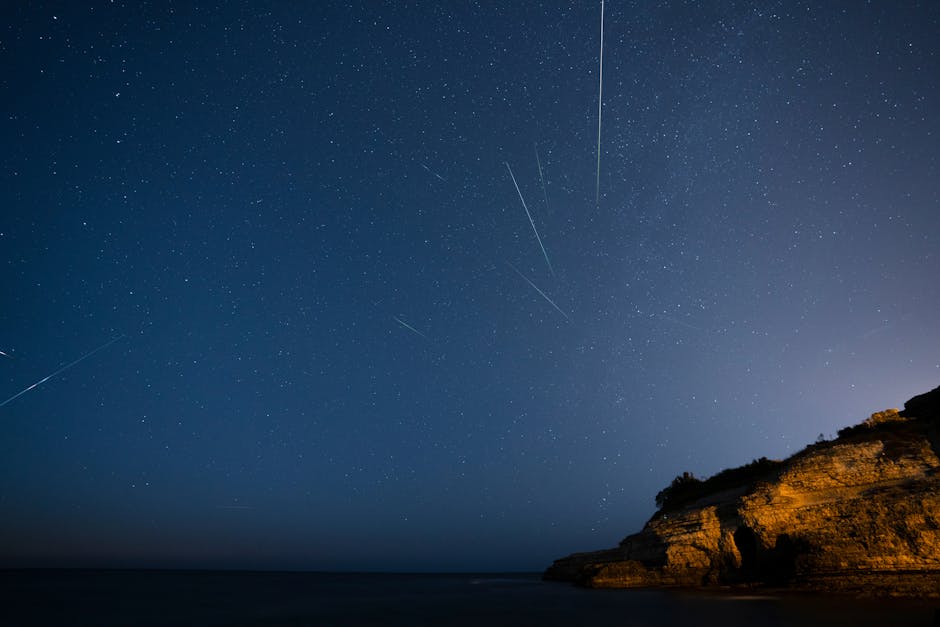
A streak of light tearing across the dark canvas, burning with a white-hot intensity before fading away into nothingness.
It is a reminder that the universe is vast, loud, and completely indifferent to us.
And honestly, I think everyone should try to see a meteor shower at least once in their life.
It is a primal experience.
It doesn’t matter if you are an astrophysicist or someone who doesn’t know a telescope from a trowel.
Seeing a shooting star is something that connects you to the history of the cosmos.
It’s kind of wild when you think about it.
We are just walking around on this spinning rock, oblivious to the fact that we are currently flying through a giant cloud of cosmic dust and ice.
And sometimes, that dust decides to burn up in our atmosphere, creating those beautiful streaks we call meteors.
If you have never seen one for yourself, or maybe you want to know how to get the best view next time, then you are in the right place.
What is a Meteor Shower?
Okay, let’s get a little bit technical but keep it simple, because otherwise it gets boring.
A meteor shower is actually just a coincidence of timing.
The Earth travels through space, right? And it travels through a debris field left behind by a comet or an asteroid. Here’s the interesting part.
These rocks and dust particles are usually tiny.
They are microscopic, really.
But when they slam into our atmosphere, they hit it at incredible speeds.
Usually, it’s like 30 miles per second.
That is insanely fast.
The air in front of them compresses so fast that it heats up instantly.
The friction turns the particle into a glowing ball of plasma, and that is what we see as a meteor.
Now, here is where it gets confusing because people use the word ‘meteor’ wrong all the time.
If you hear someone say ‘I saw a meteor in my backyard,’ they are usually talking about a fireball that actually hit the ground, or maybe just a really bright shooting star.
But technically speaking, a meteor is the light in the sky.
The rock itself is a meteoroid when it is in space. But there’s a catch.
When it enters the atmosphere and burns up, it’s a meteor.
If it survives the fall and hits the dirt, then it’s a meteorite.
It is like a language that barely makes sense.
And then there are the meteor showers, which are just a whole bunch of these rocks coming in at the same time, all from roughly the same direction in the sky.
And you have to remember, this happens every single night.
Not every night is a spectacular shower, obviously, but the sky is always active.
You will usually see at least one random meteor per hour if you are lucky.
But when there is a shower, the rates can skyrocket.
Sometimes you can see one every few minutes.
It creates a feeling of falling stars that is really hard to describe unless you are actually there under a dark sky.
When is the Best Time to Look?
This is the part where it gets tricky because a lot of people get it wrong. Oddly enough,
They see a headline that says ‘Meteor Shower Tonight!’ and they go outside at 8:00 PM.
And they wait.
And they wait.
And they freeze.
And they come back inside disappointed.
And the reason they are disappointed is because the best time to watch is usually between midnight and 3:00 AM.
I know, I know, that sounds terrible.
Who wants to be awake that late? But the earth rotates.
The part of the sky that is overhead changes as the earth spins.
Basically, the best time to watch a meteor shower is when the part of the sky that contains the radiant point (the point where the meteors seem to originate from) is as high in the sky as possible. Here’s the interesting part.
That usually happens in the early morning hours.
So, if you want to see the Perseids or the Geminids, you have to be willing to stay up late.
Or you have to be willing to get up stupidly early on a Saturday morning.
It is a commitment. And this is where things get interesting.
But I promise you, seeing your first meteor at 3:00 AM with the air crisp and the sky dark makes it totally worth the lost sleep.
- Check the moon phase. And this is where things get interesting.
A bright moon can wash out the fainter meteors.
- Look for the constellation that gives the shower its name.
- Don’t just look at one spot, scan the whole sky.
Where to Find the Darkest Skies
You can have the perfect calendar date, the clearest weather forecast, and the best equipment in the world, but if you are sitting in the middle of a city, you aren’t going to see anything.
It is called light pollution, and it is a massive problem for amateur astronomers. And this is where things get interesting.
The glow from streetlights, billboards, and houses reflects off the atmosphere and creates a kind of haze.
This haze makes it really hard to see the fainter stars and definitely kills the visibility of meteors.
A meteor needs contrast to be seen. And this is where things get interesting.
If the background sky is too bright, the streak of light just blends in.
So, you need to get away from the city.
I’m talking about driving an hour or two away.
You don’t necessarily need to go to a national park, though that is ideal.
You just need to get out of the ‘urban core.’ Anywhere with a clear view of the horizon and no bright lights in your face is going to do.
And honestly, this is the most fun part.
You get to explore.
You get to find a farm field, a remote hilltop, or a friend’s house in the middle of nowhere.
It’s like a little adventure.
You are trading the comfort of your warm bed for a sleeping bag and a thermos of coffee. But there’s a catch.
But once you get to that dark spot, the sky just explodes.
It’s like you are standing on top of the world.
There are also a lot of organizations now that track ‘dark sky parks’ and reserves.
These are protected areas specifically set aside to limit light pollution so people can do astronomy.
If you live in a developed country, there is probably one within driving distance.
And that is where you need to be. Here’s the interesting part.
The difference in visual density of stars is shocking.
In the city, you see maybe a hundred stars.
In a dark sky park, you can see thousands.
It changes your perspective completely.
The Big Players: Perseids and Geminids
While there are dozens of minor showers throughout the year, two stand head and shoulders above the rest.
They are the Perseids and the Geminids.
The Perseids are my personal favorite.
They happen in August. And this is where things get interesting.
It’s summer.
The weather is usually warm.
And the rates are incredible.
The Perseids are associated with the Comet Swift-Tuttle, which is a massive object that takes 133 years to orbit the sun.
It’s a big old dirty snowball that leaves a trail of debris everywhere it goes. Now think about that for a second.
Because the earth passes pretty close to its orbit every year, we get the Perseids.
The peak usually happens in mid-to-late August. Oddly enough,
And if you catch them right at the peak, you can see anywhere from 50 to 100 meteors per hour.
It is a non-stop show.
Then there are the Geminids. And this is where things get interesting.
These happen in December.
The weather is cold. Here’s the interesting part.
I mean, really cold.
December is prime winter weather.
But the Geminids are actually the strongest shower of the year.
They are unique because they aren’t from a comet.
They are from an asteroid called 3200 Phaethon.
That is pretty rare. But there’s a catch.
Most meteors are from comets, but the Geminids are from an asteroid.
They are also generally brighter and have a more yellowish hue than the Perseids, which tend to be more white or blue. Here’s the interesting part.
They can be quite slow too, which makes them easier to track with your eyes.
So even though you might be shivering in your coat, watching the Geminids is absolutely worth it because you see so many bright ones.
Practical Tips for Stargazing
Okay, let’s talk about logistics. But there’s a catch.
You can’t just walk out the door in your pajamas and expect to have a good time.
You need to prepare.
First off, dress warmer than you think you need to.
I don’t care how hot it is where you are standing right now.
Once the sun goes down, the temperature drops.
If you are lying on the ground, the cold hits you much faster.
Wear layers.
Bring a hat.
Bring gloves.
And bring a thermos of something hot.
Hot chocolate is classic, but coffee is better for staying awake.
Also, get a reclining chair or at least a thick blanket.
Do not try to lie flat on your back on the hard ground for two hours.
Your back will hate you.
I learned this the hard way. But there’s a catch.
You want to be able to look straight up without straining your neck.
So, a folding chair with a high back is perfect.
And bring a red flashlight.
If you use a regular white light, it will destroy your night vision.
It takes your eyes about 20 to 30 minutes to fully adapt to the dark.
If you shine a white light on them, you blind yourself and have to start all over again.
Red light doesn’t affect your night vision as much.
So, get a red flashlight or just cover your phone flashlight with a red piece of paper.
And finally, patience.
This is the hardest part.
You look up, you wait, and you see nothing.
And then you look away to talk to your friend, and you look back, and *boom*, there it is.
You have to be willing to just sit there and do nothing.
Put your phone away.
Don’t try to scroll through social media.
Just sit there and let your eyes adjust.
The shower only lasts for a few hours, so make the most of it. Now think about that for a second.
Don’t rush it.
Watching a meteor shower is more than just looking at pretty lights.
It is a moment of silence and reflection.
It is a reminder that we are just a tiny speck in a massive, beautiful machine.
It grounds you.
It reminds you that the problems of the day are small compared to the vastness of space.
It’s a little bit spiritual, even if you don’t believe in that stuff.
You just feel connected to everything.
And isn’t that what it’s all about? Finding a moment of peace in a chaotic world.
So, grab a friend, drive out to the sticks, and look up.
The show is free, and it’s always on.
And this is where things get interesting.
Image source credit: pexels.com