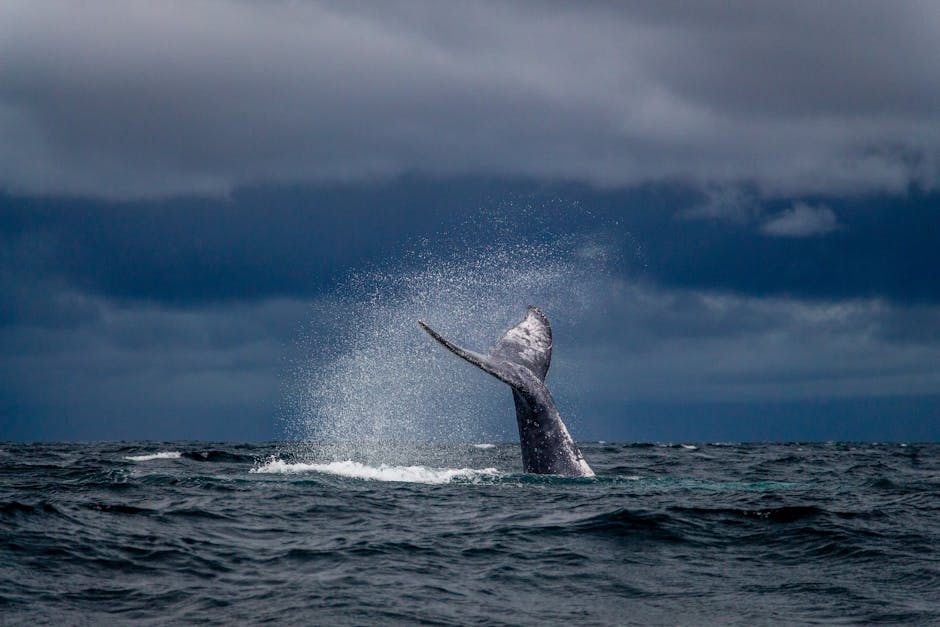
Have you ever stood on a cliff or a boat deck and just watched the horizon, waiting for that sudden, explosive blast of water? It’s honestly one of the most humbling things to experience.
When that massive grey shape breaches the surface, flapping its tail, it makes you feel pretty small.
We call them whales, but that word covers a huge amount of ground. And this is where things get interesting.
We’re talking about the largest animals to ever live on Earth, ranging from the massive Blue Whale to the acrobatic Humpback. Now think about that for a second.
There is so much more to these creatures than just their size.
From what I’ve seen, most people assume a whale is just a really big fish.
But they aren’t fish at all.
They are mammals, just like us.
They breathe air, give birth to live young, and nurse them with milk.
It’s crazy when you think about it—a totally different world underwater, but with biology that is surprisingly similar to our own.
If you are planning a trip to see them or just want to learn more about these majestic beasts, you are in the right place.
Table of Contents
- Understanding the Different Whale Species
- Why Whales Don’t Suffocate While Sleeping
- The Mysterious Art of Whale Song
- Whale Migration: A Global Journey
- Top Tips for Whale Watching
- Conservation: Why We Need to Protect Them
The Giants of the Deep: Understanding the Species
There are two main families of whales: baleen whales and toothed whales.
It sounds technical, but the difference is pretty simple.
Baleen whales, like the Blue and the Gray, have bristle-like plates in their mouths instead of teeth.
They filter massive amounts of tiny krill or fish out of the water.
It’s like drinking through a sieve, but on a colossal scale.
They can eat up to four tons of food in a single day.
Then you have the toothed whales, like the Sperm Whale and the Orca (Killer Whale).
These guys use teeth to hunt larger prey, like squid or seals.
The Orca is actually the largest member of the dolphin family, which always surprises people.
It’s a common mistake to think they are sharks because they hunt in packs, but they are fully aquatic mammals.
The Unbelievable Size of the Blue Whale
When people talk about the biggest animal, the Blue Whale is the answer.
It’s hard to grasp just how big they are.
Their tongues alone can weigh as much as an elephant, and their hearts are the size of a small car.
If you laid a Blue whale end-to-end, it could stretch across a football field.
I remember reading a statistic that their blood vessels are so wide that a human could swim through them.
It really puts things in perspective.
How Do Whales Sleep Without Drowning?
Here is a question that keeps a lot of people up at night: if they breathe air, how do they sleep? You’d think they’d suffocate if they were underwater for too long. But there’s a catch.
The trick is that they only shut down half of their brain at a time.
One half stays awake to control breathing and swimming, while the other half sleeps. Here’s the interesting part.
They might even float at the surface, bobbing up and down like a cork, before switching sides.
It’s not a deep, REM cycle like we have, but it works for them.
It’s actually a pretty efficient way to survive in a dangerous ocean.
The Language of the Ocean: Whale Song
Have you ever heard a whale song? It’s hauntingly beautiful.
Humpback whales are famous for their complex songs, which can last for hours and travel for miles through the water.
Males sing these songs to attract females or to establish dominance over other males.
It’s essentially the ocean’s version of a mating call, but way more sophisticated.
What’s really wild is that whales in different regions have different dialects.
And get this—they can learn new songs from other populations.
It’s like they have their own version of pop music that evolves over time.
It makes you wonder how much we are missing in the silence of the deep.
Whale Migration: A Marathon Run
Oddly enough,
Whales are massive travelers.
They don’t stay in one place year-round.
Depending on the species, they migrate thousands of miles every single year.
They move between cold polar waters where they feed and warm tropical waters where they give birth and nurse their calves.
The journey is tough, fighting currents and dealing with predators, but the payoff is worth it for the next generation.
Now think about that for a second.
If you are interested in tracking these giants, you can look into specific maps that show their migration paths.
It’s fascinating to see exactly where they go and when. Oddly enough,
Many researchers track them using satellite tags to see exactly how they move.
Whale Watching: Tips for the Best Experience
Seeing a whale in the wild is a bucket-list item for most of us.
But you can’t just jump in the water and hope for the best.
Safety is key. Oddly enough,
Always stay at least 100 yards away from the whale. Oddly enough,
Getting too close disturbs them and can actually hurt them.
Timing is everything.
The best time to go usually depends on where you live and what species you want to see. Now think about that for a second.
Some migrate north in the summer, while others stay in the south.
You should also choose the right boat.
A smaller, more agile boat often gets you closer without disturbing the animals, whereas massive cruise ships might scare them off.
Conservation: Why It Matters Now More Than Ever
Despite their size, whales are fragile.
They face threats from ship strikes, fishing nets (bycatch), and pollution.
Plastic waste is a huge problem because whales often mistake it for food.
Protecting their habitats is crucial for our own ecosystem, too.
They play a massive role in the ocean food web.
If you love these animals, consider supporting reputable marine conservation organizations.
There are tons of great charities out there working to clean up oceans and protect marine mammals.
Even a small donation helps with research and rescue efforts. Now think about that for a second.
It feels good to know you are contributing to their survival.
So, next time you see a photo or video of a whale breaching, remember that these are some of the most intelligent and resilient creatures on the planet.
They have survived ice ages and massive environmental changes, and they are still here, singing their songs in the deep blue.
Whether you are a casual observer or a hardcore marine biologist, there is always something new to learn about whales.
They remind us that our planet is capable of incredible things.
What is your favorite type of whale? Let me know in the comments below.
I’d love to hear your stories or tips for spotting them.
Image source: pexels.com
Image source credit: pexels.com