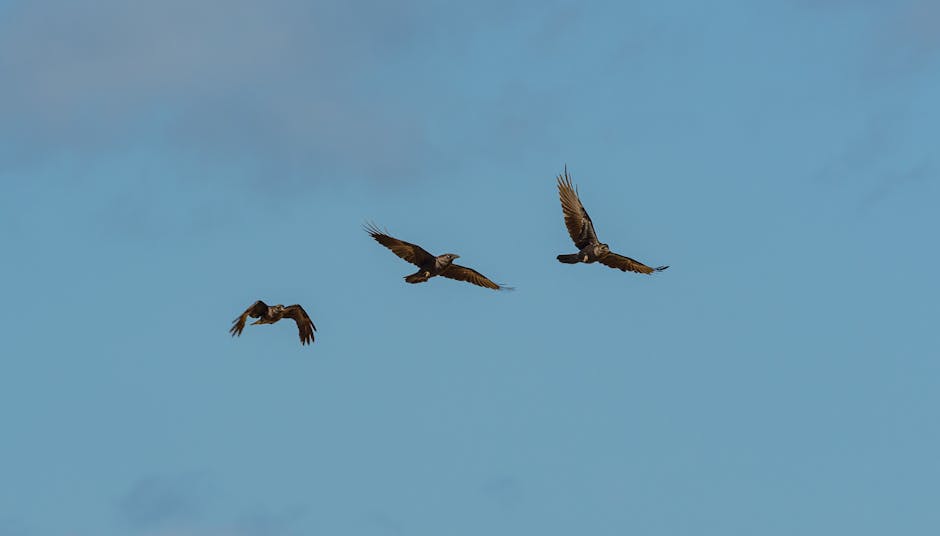
There is nothing quite like the rush of seeing a bird of prey dive through the sky.
You see a shadow, a flash of color, or a massive silhouette banking against the clouds.
Your brain immediately thinks, “Eagle!”.
But then you squint a little harder, and you aren’t so sure.
Most of us have been there.
We stand in a field with binoculars, frustrated because we can’t tell if the bird circling above is a sharp-shinned hawk or a Cooper’s hawk.
It gets even harder when you factor in eagles and falcons.
They all look like dark shapes zooming past.
But you don’t need to be an expert ornithologist to tell them apart.
From what I’ve seen, most people just need a few key details—wing shape, beak style, and flight style—to solve the mystery.
Let’s break down how to identify these incredible raptors.
The Big Three: Hawks, Eagles, and Falcons
When people say “raptor,” they usually mean one of three things: hawks, eagles, or falcons. But there’s a catch.
They share the same predatory nature, but their anatomy tells a different story.
1.
Falcons: The Speedsters
If a bird is zooming past you at Mach 10, it’s likely a falcon.
These guys are built for pure speed.
- Beak: Look for a “notched” beak.
This is called a “tooth.” It’s like a zipper on their face that they use to kill prey instantly.
- Tail: Falcom tails are long, narrow, and pointed.
They act like a rudder to help them maneuver tight turns.
- Flight: They don’t glide as much as they dive.
You’ll often see them plummeting at steep angles to catch their food.
Common North American falcons include the Peregrine Falcon, which is famous for its high-speed dives, and the Merlin, a smaller version that likes to hang out in suburbs.
2.
Hawks: The Middle Ground
Hawks are the most common raptors you’ll see. But there’s a catch.
They have adapted to almost every habitat on the planet.
- Beak: Their beaks are curved and powerful but lack the deep “tooth” of a falcon.
- Tail: Hawk tails are usually broad and square or rounded.
- Wings: Most hawks have long, rounded wings that are great for soaring and flapping.
Whether it’s a Red-tailed Hawk on a fence post or a sharp-shinned hawk in a tree, hawks are masters of using the wind.
3.
Eagles: The Giants
If the bird is huge and has a white head or tail, you’re probably looking at an eagle.
- Size: They are massive.
An eagle’s wingspan can be up to 7 feet across.
- Head: Bald eagles are easy because of their white head and tail, but Golden Eagles are brown all over with golden feathers on their nape.
- Wings: Eagles have straight, wide wings that they hold flat while soaring.
They barely flap.
How to Tell Them Apart in Flight
Spotting a bird on the ground is easy. Here’s the interesting part.
Spotting one in the air is a whole different game.
You have to watch how they move.
Soaring vs.
Flapping
Eagles love to soar.
They’ll circle high up, barely flapping their massive wings.
They ride thermals like a surfer rides a wave. Here’s the interesting part.
Hawks also soar, but they often flap their wings more rhythmically, especially when they are hunting low over fields.
Falcons are the exception.
They don’t soar much; they fly fast and low, zipping through trees and fences.
The Wing Shape Trick
Grab a pair of binoculars and look at the silhouette.
- Pointy wings usually mean falcon.
- Rounded or square wings usually mean hawk.
- Flat, wide wings usually mean eagle.
Common Mistakes Beginners Make
Even I mess this up sometimes.
One of the biggest mistakes people make is calling every big bird an “eagle.” Just because it’s big doesn’t mean it is.
You have to look for the shape.
If the bird has a rounded tail and big, fluffy chest, it’s likely a Red-tailed Hawk.
If it has a skinny tail and looks streamlined, it could be a falcon.
Another thing I’ve noticed is ignoring the feet.
Raptors kill with their feet.
An eagle’s feet are massive and powerful, designed to crush.
A falcon’s feet are designed for grabbing and holding, while a hawk’s are versatile.
If you get a good look, the size of the legs tells you a lot.
Tools to Help You ID Raptors
Getting it right the first time is hard.
You need the right gear.
I’ve been using a spotting scope for a few years now, and honestly, it’s changed how I watch birds.
You can’t see the details of a feather or the curve of a beak with cheap binoculars.
If you are just starting out, don’t spend a fortune on gear right away.
Grab a decent pair of Raptors vs Clippers: Head-to-Head Stats, Predictions, and Recent Results“>10×42 binoculars and a local field guide.
You don’t need to memorize every species; you just need to recognize the patterns.
Other Raptors to Look For
Raptors aren’t just hawks and eagles.
You have Tyler Hansbrough: The Tiny Glue That Held the Indiana Machine Together“>owls too, though they hunt at night.
Then there are vultures, which are scavengers but still fit the raptor definition. And this is where things get interesting.
If you are interested in training birds, you might look into NBA Expansion: Is The League Finally Ready to Expand, Or Just Broke?“>falconry, but that requires a lot of legal work and dedication.
Final Thoughts
Next time you see a shadow banking in the sky, take a second to really look.
Don’t just say “cool bird.” Try to see the shape of the tail and the angle of the wings.
You’ll be surprised at how much information is hidden in plain sight.
Remember, nature isn’t always perfect.
Sometimes a bird is moulting and looks weird, or it’s a hybrid.
Don’t stress too much about getting the name 100% right.
The point is to connect with the wild.
The more you watch, the better you get.
Now think about that for a second.
Quick Reference Cheat Sheet
- Falcon: Notched beak, pointed wings, very fast.
- Hawk: Curved beak, rounded wings, common.
- Eagle: Massive size, flat wings, glides high.
Image source: pexels.com
Image source credit: pexels.com